From a class of 28 students, in how many ways could a teacher select 4 students to lead the class discussion?
Table of contents
- 0. Review of Algebra4h 18m
- 1. Equations & Inequalities3h 18m
- 2. Graphs of Equations1h 43m
- 3. Functions2h 17m
- 4. Polynomial Functions1h 44m
- 5. Rational Functions1h 23m
- 6. Exponential & Logarithmic Functions2h 28m
- 7. Systems of Equations & Matrices4h 5m
- 8. Conic Sections2h 23m
- 9. Sequences, Series, & Induction1h 22m
- 10. Combinatorics & Probability1h 45m
- Appendix 1. Review of Real Numbers2h 24m
- Appendix 2. Linear Equations and Inequalities3h 42m
- OLD 9. Sequences, Induction, and Probability Coming soon
- 1. - OLD - Fundamental Concepts of Algebra Coming soon
- 2. - OLD - Equations and Inequalities Coming soon
- OLD 4. Rational Functions Coming soon
- OLD 2. Functions & Graphs Coming soon
- OLD 6. Exponential and Logarithmic Functions Coming soon
- OLD 7. Systems of Equations and Inequalities Coming soon
- OLD 8. Matrices and Determinants Coming soon
- OLD 9. Conic Sections Coming soon
10. Combinatorics & Probability
Combinatorics
Problem 41
Textbook Question
Find the term indicated in each expansion. (x − 1)9; fifth term
Verified step by step guidance1
Identify the general term formula for the binomial expansion of \((x - 1)^9\). The \(k\)-th term is given by \(T_{k+1} = \binom{9}{k} x^{9-k} (-1)^k\) where \(k\) starts from 0.
Since we want the fifth term, set \(k = 4\) because the first term corresponds to \(k=0\).
Substitute \(k=4\) into the general term formula: \(T_5 = \binom{9}{4} x^{9-4} (-1)^4\).
Calculate the binomial coefficient \(\binom{9}{4}\) using the formula \(\binom{n}{r} = \frac{n!}{r!(n-r)!}\), but do not compute the numerical value yet.
Write the fifth term as \(T_5 = \binom{9}{4} x^5 (1)\) since \((-1)^4 = 1\), and this expression represents the fifth term in the expansion.
Verified video answer for a similar problem:This video solution was recommended by our tutors as helpful for the problem above
Video duration:
3mPlay a video:
0 Comments
Key Concepts
Here are the essential concepts you must grasp in order to answer the question correctly.
Binomial Theorem
The Binomial Theorem provides a formula to expand expressions of the form (a + b)^n. It states that the expansion is the sum of terms involving binomial coefficients, powers of a, and powers of b. This theorem is essential for finding specific terms in binomial expansions.
Recommended video:
Guided course
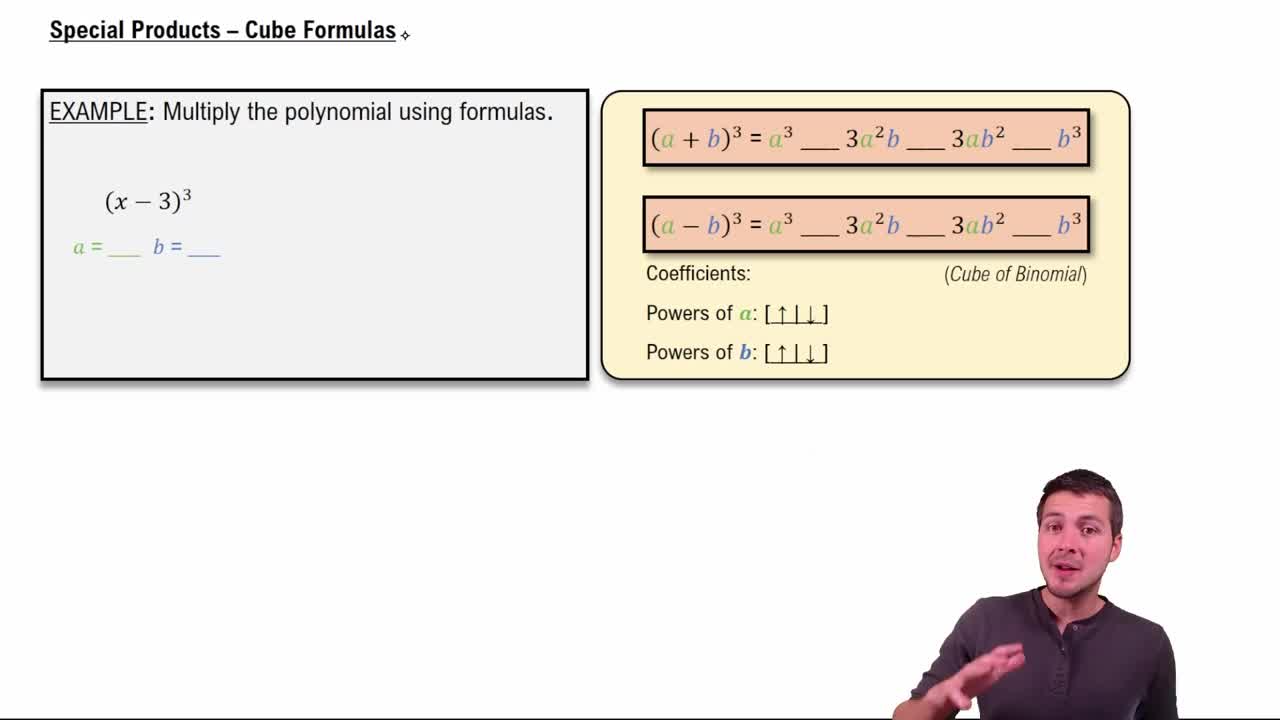
Special Products - Cube Formulas
Binomial Coefficients
Binomial coefficients, denoted as C(n, k) or "n choose k," represent the number of ways to choose k elements from n. They appear as coefficients in the binomial expansion and can be calculated using factorials or Pascal's Triangle. These coefficients determine the weight of each term.
Recommended video:
Guided course
Special Products - Cube Formulas
Term Identification in Binomial Expansion
In the expansion of (x + y)^n, the (k+1)-th term is given by C(n, k) * x^(n-k) * y^k. To find the fifth term, substitute k = 4. Understanding this formula allows you to directly compute any specific term without expanding the entire expression.
Recommended video:
Guided course
Introduction to Polynomials
Related Videos
Related Practice
Multiple Choice