Find all complex zeros of each polynomial function. Give exact values. List multiple zeros as necessary.* ƒ(x)=5x3-9x2+28x+6
Table of contents
- 0. Review of Algebra4h 18m
- 1. Equations & Inequalities3h 18m
- 2. Graphs of Equations1h 43m
- 3. Functions2h 17m
- 4. Polynomial Functions1h 44m
- 5. Rational Functions1h 23m
- 6. Exponential & Logarithmic Functions2h 28m
- 7. Systems of Equations & Matrices4h 5m
- 8. Conic Sections2h 23m
- 9. Sequences, Series, & Induction1h 22m
- 10. Combinatorics & Probability1h 45m
- Appendix 1. Review of Real Numbers2h 24m
- Appendix 2. Linear Equations and Inequalities3h 42m
- OLD 9. Sequences, Induction, and Probability Coming soon
- 1. - OLD - Fundamental Concepts of Algebra Coming soon
- 2. - OLD - Equations and Inequalities Coming soon
- OLD 4. Rational Functions Coming soon
- OLD 2. Functions & Graphs Coming soon
- OLD 6. Exponential and Logarithmic Functions Coming soon
- OLD 7. Systems of Equations and Inequalities Coming soon
- OLD 8. Matrices and Determinants Coming soon
- OLD 9. Conic Sections Coming soon
4. Polynomial Functions
Zeros of Polynomial Functions
Problem 15
Textbook Question
Use the factor theorem and synthetic division to determine whether the second polynomial is a factor of the first. 4x2+2x+54; x-4
Verified step by step guidance1
Identify the polynomials involved: the first polynomial is \$4x^2 + 2x + 54\( and the second polynomial is \)x - 4$.
Use the Factor Theorem, which states that if \(x - c\) is a factor of a polynomial, then the polynomial evaluated at \(x = c\) equals zero. Here, set \(x = 4\) because the factor is \(x - 4\).
Evaluate the first polynomial at \(x = 4\) by substituting 4 into \$4x^2 + 2x + 54\(, which means calculating \)4(4)^2 + 2(4) + 54$.
Perform synthetic division by dividing the first polynomial by \(x - 4\). Set up synthetic division with 4 as the divisor and the coefficients of the first polynomial: 4, 2, and 54.
Analyze the remainder from synthetic division: if the remainder is zero, then \(x - 4\) is a factor of the first polynomial; if not, it is not a factor.
Verified video answer for a similar problem:This video solution was recommended by our tutors as helpful for the problem above
Video duration:
3mPlay a video:
0 Comments
Key Concepts
Here are the essential concepts you must grasp in order to answer the question correctly.
Factor Theorem
The Factor Theorem states that a polynomial f(x) has a factor (x - c) if and only if f(c) = 0. To use it, substitute c into the polynomial; if the result is zero, then (x - c) divides the polynomial exactly.
Recommended video:
Guided course
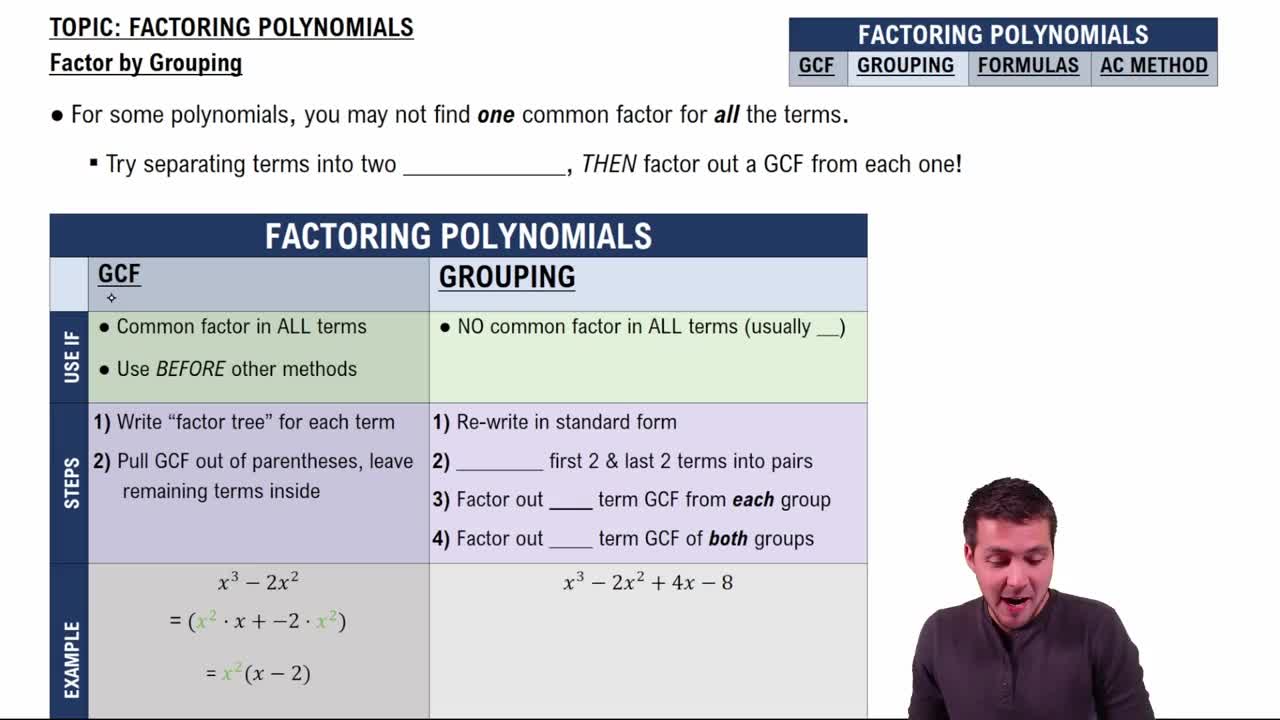
Factor by Grouping
Synthetic Division
Synthetic division is a shortcut method for dividing a polynomial by a linear factor of the form (x - c). It simplifies the division process by using only the coefficients, making it faster to find the quotient and remainder.
Recommended video:
Higher Powers of i
Polynomial Factorization
Polynomial factorization involves expressing a polynomial as a product of its factors. Determining if one polynomial is a factor of another helps simplify expressions and solve polynomial equations by breaking them into simpler components.
Recommended video:
Guided course
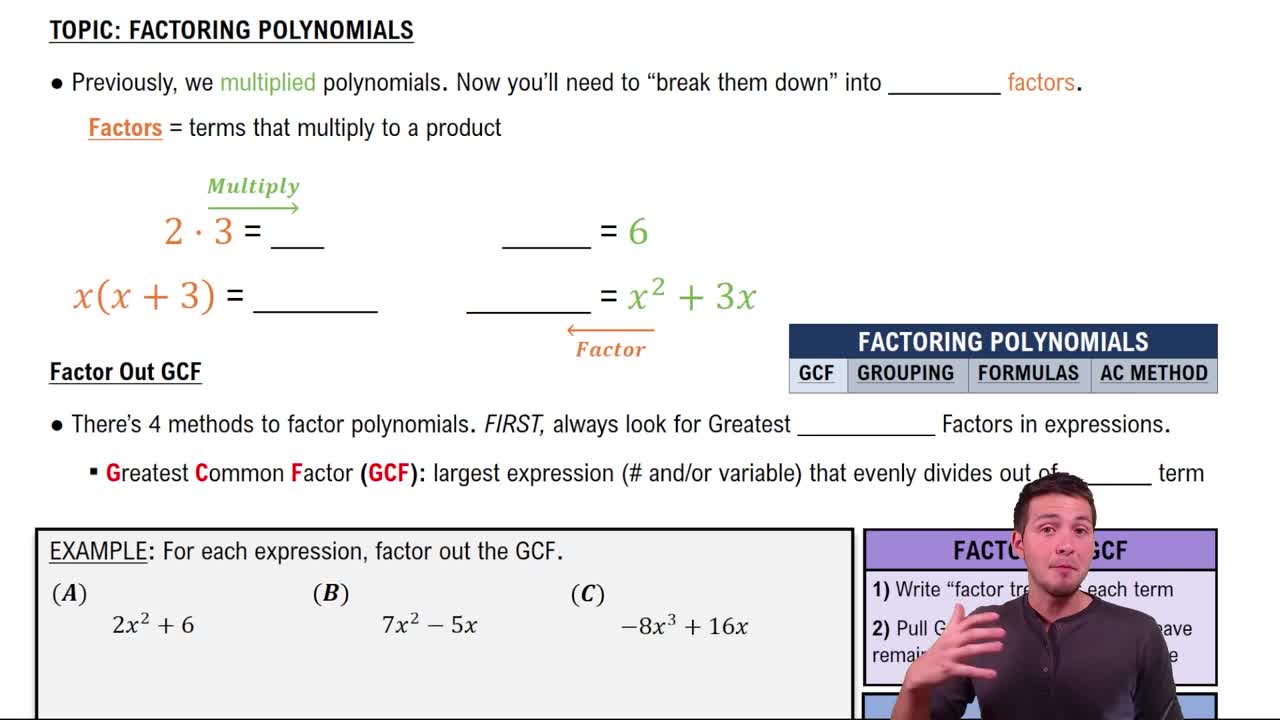
Introduction to Factoring Polynomials
Related Videos
Related Practice
Textbook Question