Use the definition of inverses to determine whether ƒ and g are inverses. f(x) = x+1/x-2, g(x) = 2x+1/x-1
Verified step by step guidance
1
Recall that two functions \( f \) and \( g \) are inverses if and only if \( f(g(x)) = x \) and \( g(f(x)) = x \). This means composing one function with the other returns the original input \( x \).
Start by finding the composition \( f(g(x)) \). Substitute \( g(x) = \frac{2x+1}{x-1} \) into \( f(x) = \frac{x+1}{x-2} \), so \( f(g(x)) = \frac{\frac{2x+1}{x-1} + 1}{\frac{2x+1}{x-1} - 2} \).
Simplify the numerator and denominator of \( f(g(x)) \) by combining terms over a common denominator. For the numerator: \( \frac{2x+1}{x-1} + 1 = \frac{2x+1}{x-1} + \frac{x-1}{x-1} \). For the denominator: \( \frac{2x+1}{x-1} - 2 = \frac{2x+1}{x-1} - \frac{2(x-1)}{x-1} \).
After simplifying both numerator and denominator, write \( f(g(x)) \) as a single rational expression and check if it simplifies to \( x \).
Next, find \( g(f(x)) \) by substituting \( f(x) = \frac{x+1}{x-2} \) into \( g(x) = \frac{2x+1}{x-1} \), so \( g(f(x)) = \frac{2 \cdot \frac{x+1}{x-2} + 1}{\frac{x+1}{x-2} - 1} \). Simplify this expression similarly and check if it equals \( x \). If both compositions simplify to \( x \), then \( f \) and \( g \) are inverses.
Verified video answer for a similar problem:
This video solution was recommended by our tutors as helpful for the problem above
Video duration:
4m
Play a video:
0 Comments
Key Concepts
Here are the essential concepts you must grasp in order to answer the question correctly.
Definition of Inverse Functions
Two functions f and g are inverses if applying one after the other returns the original input, meaning f(g(x)) = x and g(f(x)) = x for all x in their domains. This relationship shows that each function 'undoes' the effect of the other.
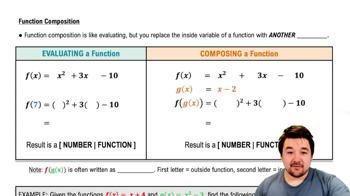
Function composition involves substituting one function into another, denoted as (f ∘ g)(x) = f(g(x)). To verify inverses, you compute both f(g(x)) and g(f(x)) and check if both simplify to x, confirming the inverse relationship.
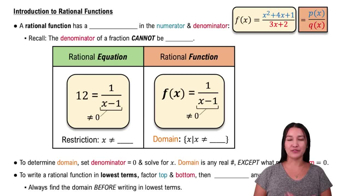
When working with rational functions like f(x) = (x+1)/(x-2), it's important to consider domain restrictions (values that make denominators zero) and carefully simplify compositions to avoid undefined expressions and correctly verify inverse properties.

 4:44 minutes
 Verified step by step guidance
 4:30
4:30