Height of a Projected Ball An astronaut on the moon throws a baseball upward. The astronaut is 6 ft, 6 in. tall, and the initial velocity of the ball is 30 ft per sec. The height s of the ball in feet is given by the equations=-2.7t2+30t+6.5,where t is the number of seconds after the ball was thrown. (a) After how many seconds is the ball 12 ft above the moon's surface? Round to the nearest hundredth. (b) How many seconds will it take for the ball to hit the moon's surface? Round to the nearest hundredth.
Ch. 1 - Equations and Inequalities

Chapter 2, Problem 48
Solve each equation using completing the square. 3x2 - 9x + 7 = 0
Verified step by step guidance1
Start with the given quadratic equation: \(3x^2 - 9x + 7 = 0\).
Divide every term by the coefficient of \(x^2\) (which is 3) to make the coefficient of \(x^2\) equal to 1: \(x^2 - 3x + \frac{7}{3} = 0\).
Move the constant term to the right side of the equation: \(x^2 - 3x = -\frac{7}{3}\).
To complete the square, take half of the coefficient of \(x\) (which is \(-3\)), square it, and add it to both sides. Half of \(-3\) is \(-\frac{3}{2}\), and its square is \(\left(-\frac{3}{2}\right)^2 = \frac{9}{4}\): \(x^2 - 3x + \frac{9}{4} = -\frac{7}{3} + \frac{9}{4}\).
Rewrite the left side as a perfect square trinomial: \(\left(x - \frac{3}{2}\right)^2 = -\frac{7}{3} + \frac{9}{4}\). Then, simplify the right side by finding a common denominator and combining the fractions.

Verified video answer for a similar problem:
This video solution was recommended by our tutors as helpful for the problem above.
Video duration:
4mWas this helpful?
Key Concepts
Here are the essential concepts you must grasp in order to answer the question correctly.
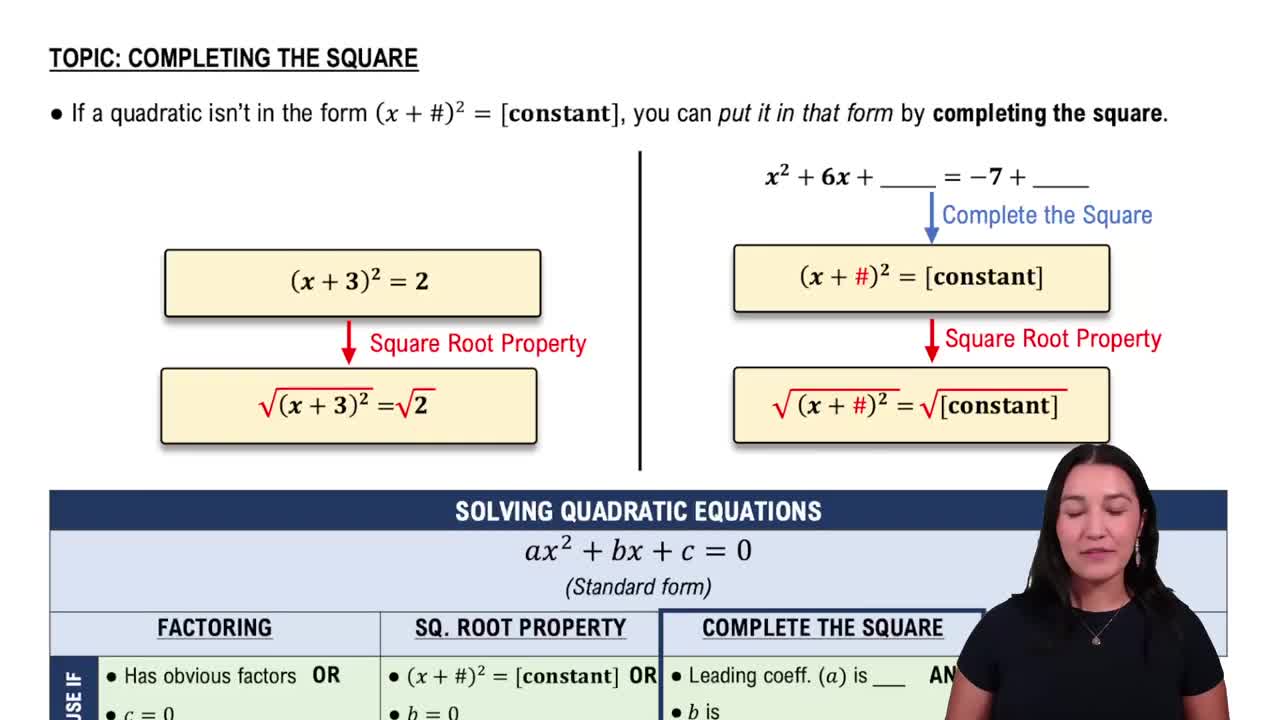
Completing the Square
Completing the square is a method used to solve quadratic equations by transforming the equation into a perfect square trinomial. This involves creating a binomial squared expression on one side, making it easier to solve for the variable by taking square roots.
Recommended video:
Solving Quadratic Equations by Completing the Square
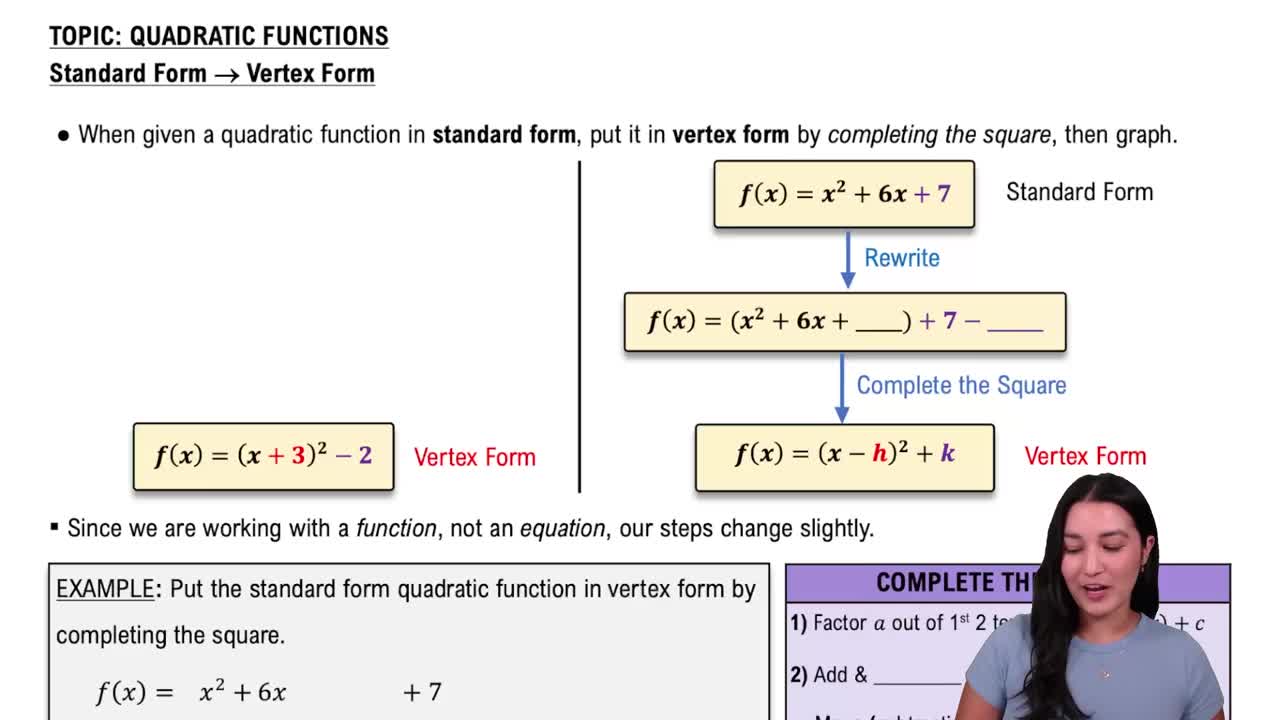
Quadratic Equation Standard Form
A quadratic equation is typically written in the form ax² + bx + c = 0, where a, b, and c are constants. Understanding this form is essential for applying methods like completing the square, as it helps identify coefficients and manipulate the equation correctly.
Recommended video:
Converting Standard Form to Vertex Form
Isolating the Variable
Isolating the variable involves rearranging the equation so that the variable term is alone on one side. In completing the square, this step is crucial to set up the equation for creating a perfect square trinomial and eventually solving for the variable.
Recommended video:
Guided course
Equations with Two Variables
Related Practice
Textbook Question
Textbook Question
Solve each quadratic inequality. Give the solution set in interval notation. x(x-1)≤6
Textbook Question
Solve each equation or inequality. | 5x + 2 | - 2 < 3
Textbook Question
Solve each formula for the specified variable. Assume that the denominator is not 0 if variables appear in the denominator. z = (x-μ)/σ, for x (standardized value)
Textbook Question
Solve each equation. √(4x+13) = 2x-1
Textbook Question
Find each sum or difference. Write answers in standard form. (3+2i) + (9+3i)