Write an equation for each line described. Give answers in standard form for Exercises 11–20 and in slope-intercept form (if possible) for Exercises 21–32. x-intercept (3,0), y-intercept (0,-2)
Verified step by step guidance
1
Identify the two points given: the x-intercept at (3, 0) and the y-intercept at (0, -2). These points lie on the line you need to find.
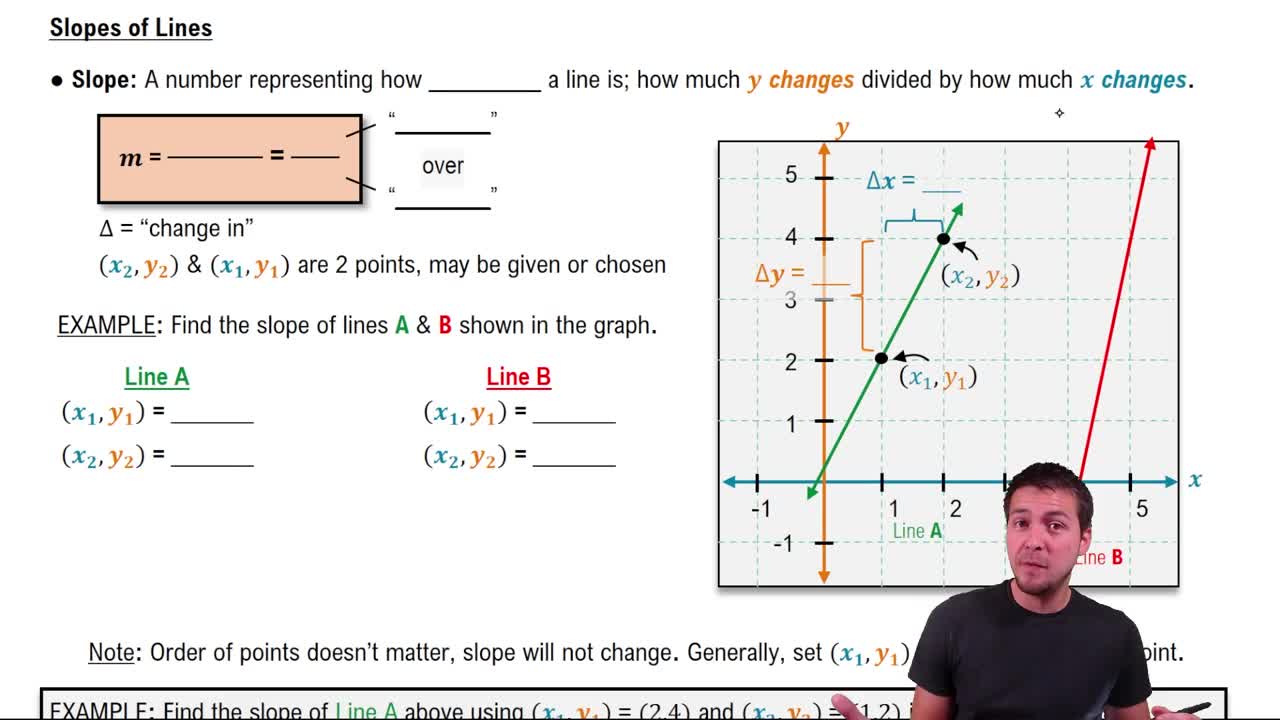
Calculate the slope \( m \) of the line using the formula \( m = \frac{y_2 - y_1}{x_2 - x_1} \). Substitute the points \( (x_1, y_1) = (3, 0) \) and \( (x_2, y_2) = (0, -2) \) into the formula.
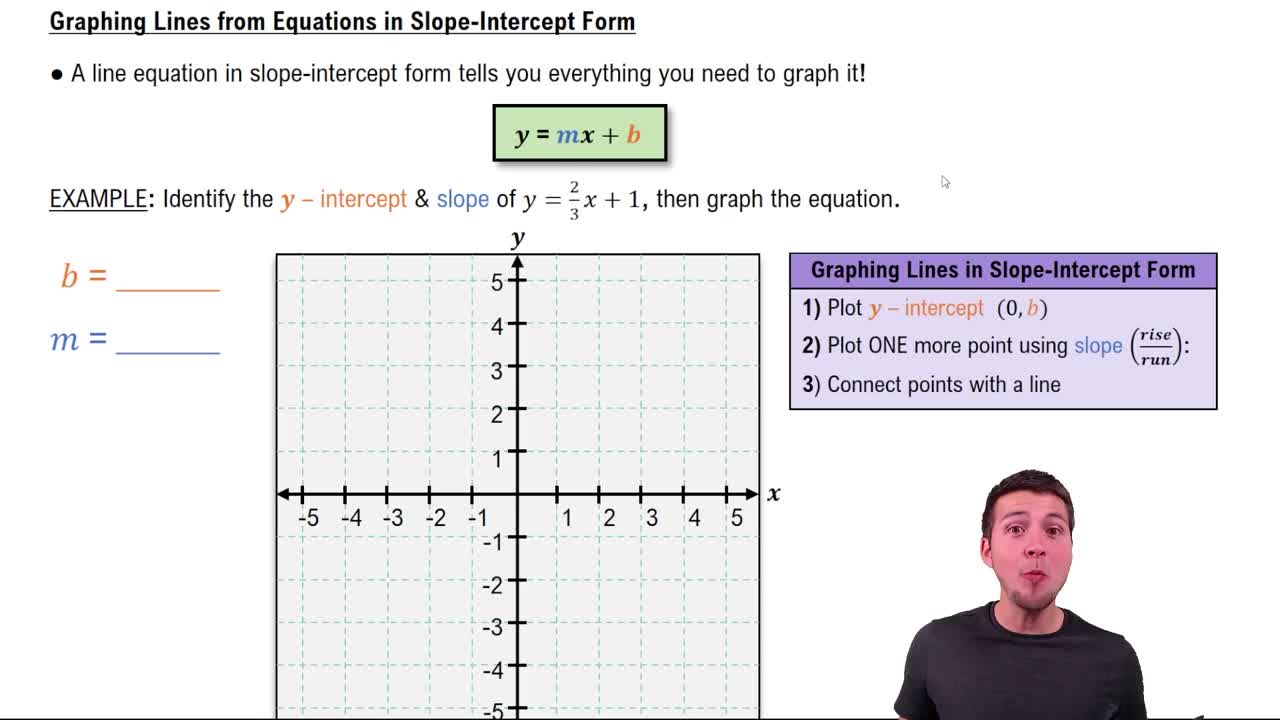
Use the slope-intercept form of a line equation, \( y = mx + b \), where \( m \) is the slope found in the previous step and \( b \) is the y-intercept. Since the y-intercept is given as (0, -2), \( b = -2 \).
Write the equation in slope-intercept form by substituting the values of \( m \) and \( b \) into \( y = mx + b \).
Convert the slope-intercept form to standard form \( Ax + By = C \) by rearranging the terms so that all variables are on one side and the constant is on the other, with \( A \), \( B \), and \( C \) as integers and \( A \geq 0 \).
Verified video answer for a similar problem:
This video solution was recommended by our tutors as helpful for the problem above
Video duration:
3m
Play a video:
0 Comments
Key Concepts
Here are the essential concepts you must grasp in order to answer the question correctly.
Intercepts of a Line
Intercepts are points where a line crosses the axes. The x-intercept is where the line crosses the x-axis (y=0), and the y-intercept is where it crosses the y-axis (x=0). Knowing both intercepts allows you to determine the line's equation by connecting these points.
The slope measures the steepness of a line and is calculated as the change in y divided by the change in x between two points. Using the intercepts, slope = (y2 - y1) / (x2 - x1). The slope is essential for writing the line's equation in slope-intercept form.
Linear equations can be expressed in various forms, including standard form (Ax + By = C) and slope-intercept form (y = mx + b). Standard form is useful for certain applications, while slope-intercept form clearly shows the slope and y-intercept, aiding graphing and interpretation.

 3:23 minutes
 Verified step by step guidance
 02:35
02:35