Which graphs in Exercises 29–34 represent functions that have inverse functions?
Verified step by step guidance
1
Step 1: Understand the problem. We need to determine if the graph shown represents a function that has an inverse function.
Step 2: Recall the definition of a function having an inverse. A function has an inverse if and only if it is one-to-one, meaning it passes the Horizontal Line Test (no horizontal line intersects the graph more than once).
Step 3: Analyze the graph. The graph is a semicircle above the x-axis centered at the origin. This means for some x-values, there is exactly one y-value, but for others, the horizontal line will intersect the graph more than once.
Step 4: Apply the Horizontal Line Test. Since the semicircle is curved and symmetric, horizontal lines near the top of the semicircle will intersect the graph twice, failing the test.
Step 5: Conclusion: Because the graph fails the Horizontal Line Test, it does not represent a function that has an inverse function.
Verified video answer for a similar problem:
This video solution was recommended by our tutors as helpful for the problem above
Video duration:
3m
Play a video:
0 Comments
Key Concepts
Here are the essential concepts you must grasp in order to answer the question correctly.
Definition of a Function
A function assigns exactly one output value for each input value. This means that for every x-value in the domain, there is only one corresponding y-value. Understanding this is essential to determine if a graph represents a function.
The horizontal line test is used to determine if a function has an inverse that is also a function. If any horizontal line intersects the graph more than once, the function fails the test and does not have an inverse function.
An inverse function reverses the roles of inputs and outputs of the original function. For a function to have an inverse function, it must be one-to-one, meaning each output corresponds to exactly one input.

 3:22 minutes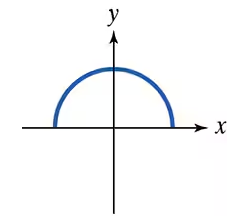
 Verified step by step guidance
 5:57
5:57