Find the horizontal asymptote of each function.
Table of contents
- 0. Review of Algebra4h 18m
- 1. Equations & Inequalities3h 18m
- 2. Graphs of Equations1h 43m
- 3. Functions2h 17m
- 4. Polynomial Functions1h 44m
- 5. Rational Functions1h 23m
- 6. Exponential & Logarithmic Functions2h 28m
- 7. Systems of Equations & Matrices4h 5m
- 8. Conic Sections2h 23m
- 9. Sequences, Series, & Induction1h 22m
- 10. Combinatorics & Probability1h 45m
- Appendix 1. Review of Real Numbers2h 24m
- Appendix 2. Linear Equations and Inequalities3h 42m
- OLD 9. Sequences, Induction, and Probability Coming soon
- 1. - OLD - Fundamental Concepts of Algebra Coming soon
- 2. - OLD - Equations and Inequalities Coming soon
- OLD 4. Rational Functions Coming soon
- OLD 2. Functions & Graphs Coming soon
- OLD 6. Exponential and Logarithmic Functions Coming soon
- OLD 7. Systems of Equations and Inequalities Coming soon
- OLD 8. Matrices and Determinants Coming soon
- OLD 9. Conic Sections Coming soon
5. Rational Functions
Asymptotes
Problem 11
Textbook Question
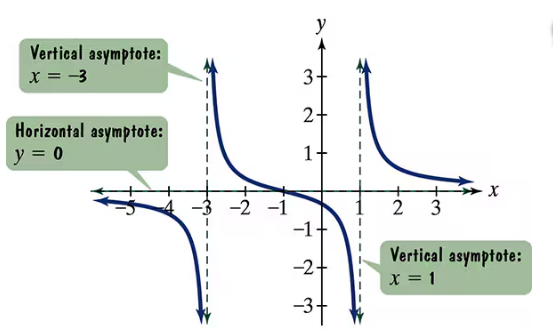
Use the graph of the rational function in the figure shown to complete each statement in Exercises 9–14.

As ______
Verified step by step guidance1
Identify the point of interest on the x-axis, which is \(x \to 1^-\), meaning we are approaching 1 from the left side.
Look at the graph near \(x = 1\) and observe the behavior of the function \(f(x)\) as \(x\) approaches 1 from values less than 1.
Notice that the graph is very close to the horizontal asymptote \(y = 0\) near \(x = 1\), and the function values are slightly below zero.
Since the function values are approaching zero from the negative side as \(x\) approaches 1 from the left, we conclude that \(f(x) \to 0^-\) as \(x \to 1^-\).
Therefore, the limit of \(f(x)\) as \(x\) approaches 1 from the left is 0, but the function values are slightly negative.
Verified video answer for a similar problem:This video solution was recommended by our tutors as helpful for the problem above
Video duration:
1mPlay a video:
0 Comments
Key Concepts
Here are the essential concepts you must grasp in order to answer the question correctly.
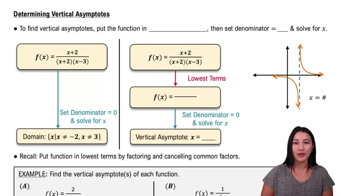
Vertical Asymptotes
Vertical asymptotes occur where a function approaches infinity or negative infinity as the input approaches a specific value. They indicate values of x where the function is undefined, often due to division by zero in rational functions. In the graph, vertical asymptotes are shown at x = 6 and x = 14.
Recommended video:
Determining Vertical Asymptotes
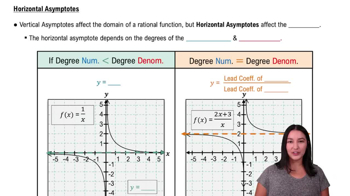
Horizontal Asymptotes
A horizontal asymptote represents the value that a function approaches as x approaches positive or negative infinity. It shows the end behavior of the function. In this graph, the horizontal asymptote is y = 0, meaning the function values get closer to zero as x becomes very large or very small.
Recommended video:
Determining Horizontal Asymptotes
Limit Behavior Near a Point
The limit of a function as x approaches a specific value from the left or right describes the function's behavior near that point. For example, as x approaches 1 from the left (x → 1⁻), the function value approaches a certain number or infinity. Understanding this helps in analyzing function continuity and asymptotic behavior.
Recommended video:
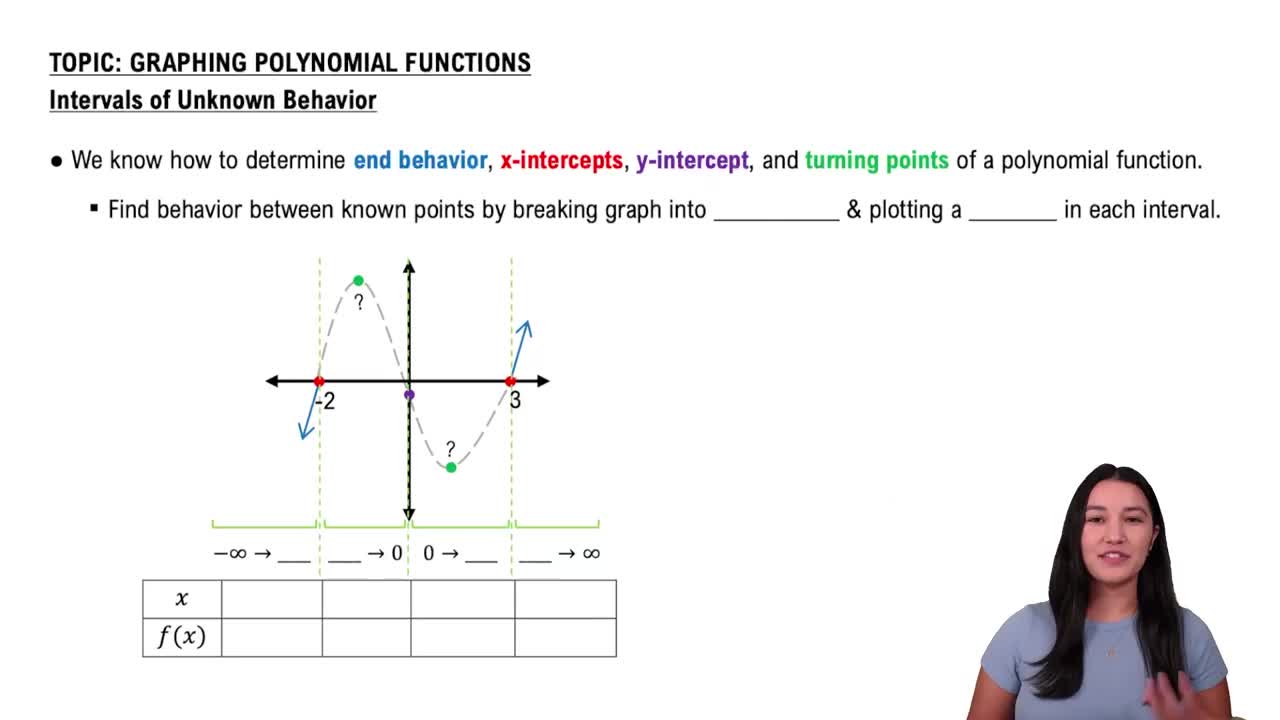
Identifying Intervals of Unknown Behavior
Related Videos
Related Practice
Multiple Choice
3
views