Evaluate or simplify each expression without using a calculator. 10log ∛x
Verified step by step guidance
1
Recognize that the expression is \(10^{(\log \sqrt[3]{x})}\), where \(\log\) denotes the logarithm base 10.
Recall the property of logarithms and exponents: \(a^{\log_a b} = b\). Here, the base of the exponent and the base of the logarithm are both 10, so this property applies.
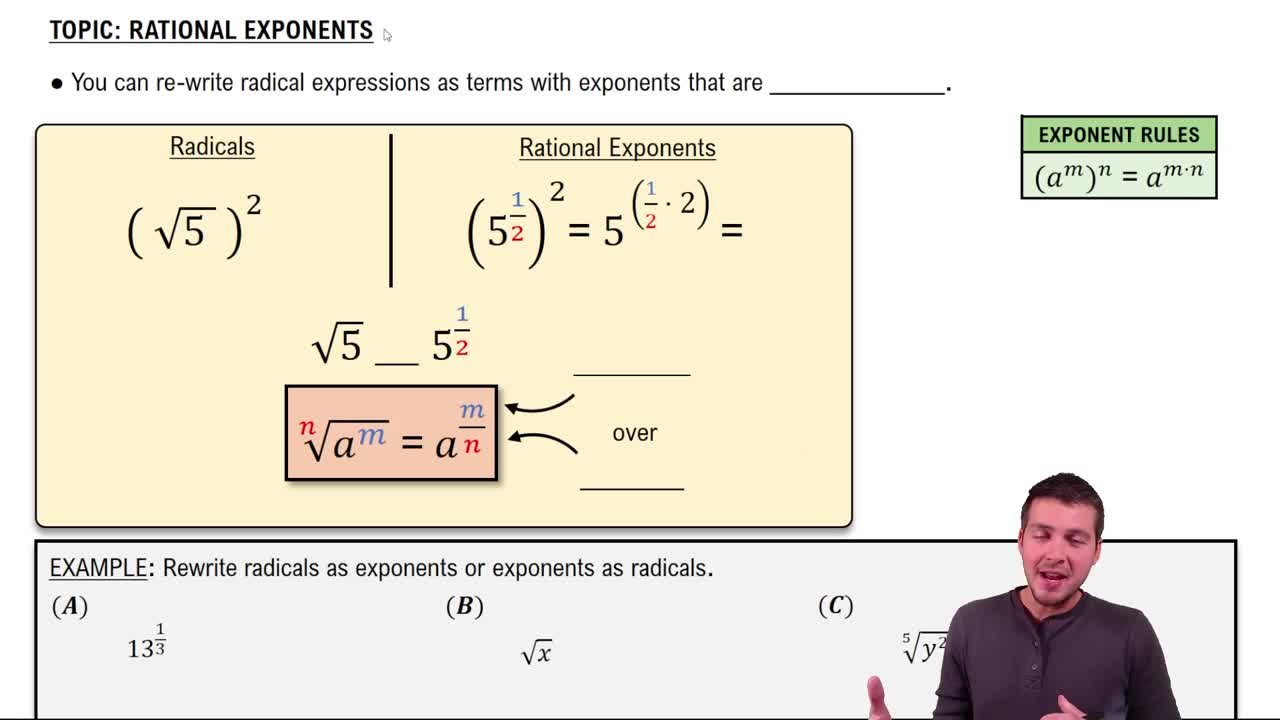
Rewrite the expression inside the logarithm: \(\sqrt[3]{x} = x^{\frac{1}{3}}\).
Apply the logarithm power rule: \(\log(x^{\frac{1}{3}}) = \frac{1}{3} \log x\).
Use the exponent and logarithm property to simplify: \(10^{\log \sqrt[3]{x}} = 10^{\frac{1}{3} \log x} = (10^{\log x})^{\frac{1}{3}} = x^{\frac{1}{3}}\).
Verified video answer for a similar problem:
This video solution was recommended by our tutors as helpful for the problem above
Video duration:
1m
Play a video:
0 Comments
Key Concepts
Here are the essential concepts you must grasp in order to answer the question correctly.
Properties of Logarithms
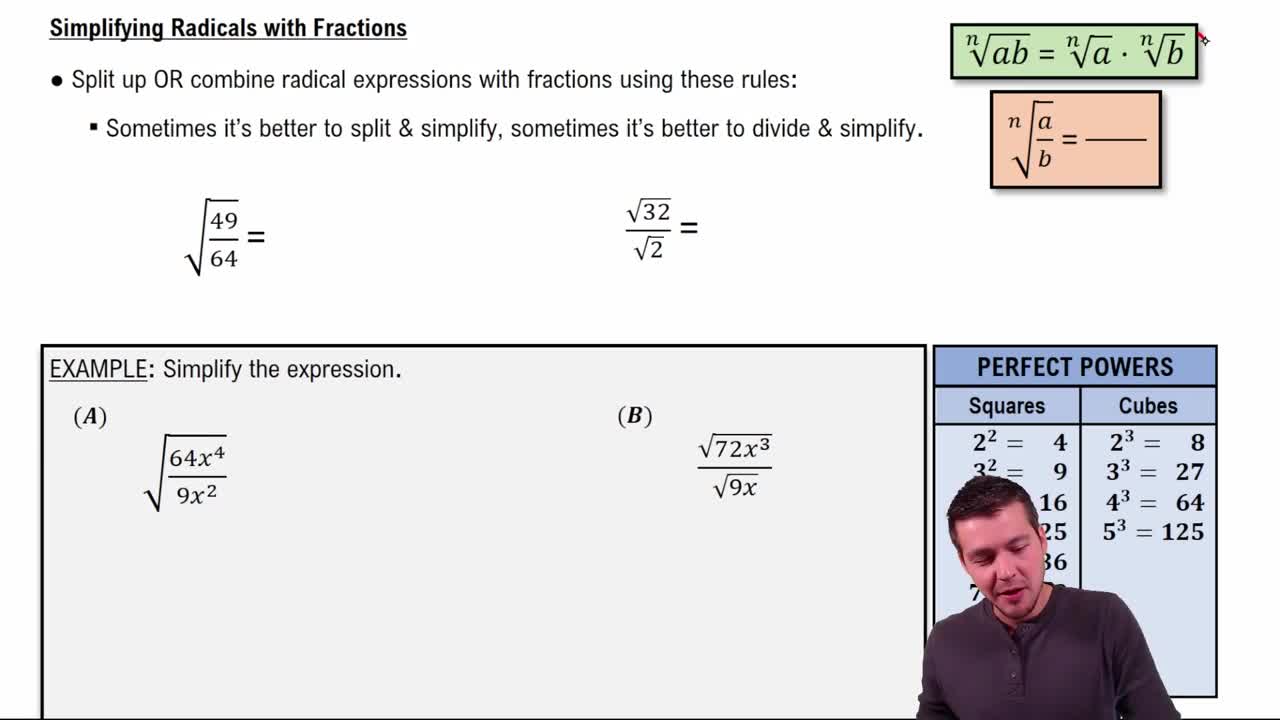
Logarithms have specific properties that simplify expressions, such as the power rule: log(a^b) = b·log(a). Understanding these properties allows you to rewrite and simplify complex logarithmic expressions effectively.
Exponents and logarithms are inverse operations. For example, 10^(log x) = x when the log base is 10. This inverse relationship helps simplify expressions where an exponent is a logarithm.
Radicals like ∛x can be expressed as fractional exponents (x^(1/3)). Converting radicals to fractional exponents makes it easier to apply logarithmic and exponential rules during simplification.

 1:20 minutes
 Verified step by step guidance
 5:36
5:36