Use an end behavior diagram, as shown below, to describe the end behavior of the graph of each polynomial function. ƒ(x)=3+2x-4x2-5x10
Table of contents
- 0. Review of Algebra4h 18m
- 1. Equations & Inequalities3h 18m
- 2. Graphs of Equations1h 43m
- 3. Functions2h 17m
- 4. Polynomial Functions1h 44m
- 5. Rational Functions1h 23m
- 6. Exponential & Logarithmic Functions2h 28m
- 7. Systems of Equations & Matrices4h 5m
- 8. Conic Sections2h 23m
- 9. Sequences, Series, & Induction1h 22m
- 10. Combinatorics & Probability1h 45m
- Appendix 1. Review of Real Numbers2h 24m
- Appendix 2. Linear Equations and Inequalities3h 42m
- OLD 9. Sequences, Induction, and Probability Coming soon
- 1. - OLD - Fundamental Concepts of Algebra Coming soon
- 2. - OLD - Equations and Inequalities Coming soon
- OLD 4. Rational Functions Coming soon
- OLD 2. Functions & Graphs Coming soon
- OLD 6. Exponential and Logarithmic Functions Coming soon
- OLD 7. Systems of Equations and Inequalities Coming soon
- OLD 8. Matrices and Determinants Coming soon
- OLD 9. Conic Sections Coming soon
4. Polynomial Functions
Understanding Polynomial Functions
Problem 31
Textbook Question
Graph each polynomial function. Factor first if the polynomial is not in factored form. ƒ(x)=-2x(x-3)(x+2)
Verified step by step guidance1
Identify the given polynomial function: \(f(x) = -2x(x-3)(x+2)\). Notice that it is already factored into three linear factors multiplied together.
Determine the zeros of the function by setting each factor equal to zero: \(x = 0\), \(x - 3 = 0 \Rightarrow x = 3\), and \(x + 2 = 0 \Rightarrow x = -2\). These are the x-intercepts of the graph.
Analyze the leading coefficient and degree to understand the end behavior. The leading term comes from multiplying \(-2x\), \(x\), \(x-3\), and \(x+2\). Since there are three linear factors and a coefficient of \(-2\), the degree is 3 (odd degree) and the leading coefficient is negative, so the graph falls to the right and rises to the left.
Find the y-intercept by evaluating \(f(0)\). Substitute \(x=0\) into the function: \(f(0) = -2 \times 0 \times (0-3) \times (0+2)\). This will give the point where the graph crosses the y-axis.
Plot the zeros and the y-intercept on the coordinate plane. Then, sketch the graph using the end behavior and the fact that the graph crosses the x-axis at the zeros. The graph will pass through each zero and change direction accordingly.
Verified video answer for a similar problem:This video solution was recommended by our tutors as helpful for the problem above
Video duration:
6mPlay a video:
0 Comments
Key Concepts
Here are the essential concepts you must grasp in order to answer the question correctly.
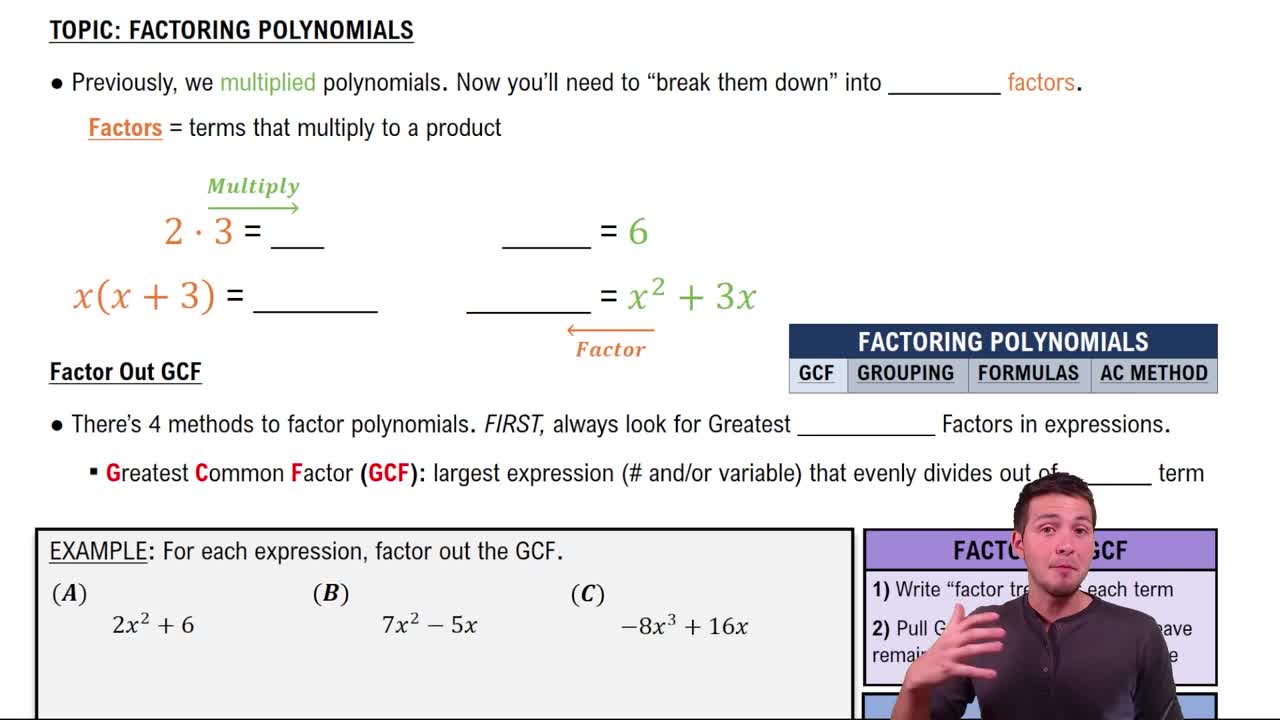
Factoring Polynomial Functions
Factoring involves expressing a polynomial as a product of its factors, which simplifies finding roots and analyzing the function. In this question, the polynomial is already factored as -2x(x-3)(x+2), making it easier to identify zeros and graph the function.
Recommended video:
Guided course
Introduction to Factoring Polynomials
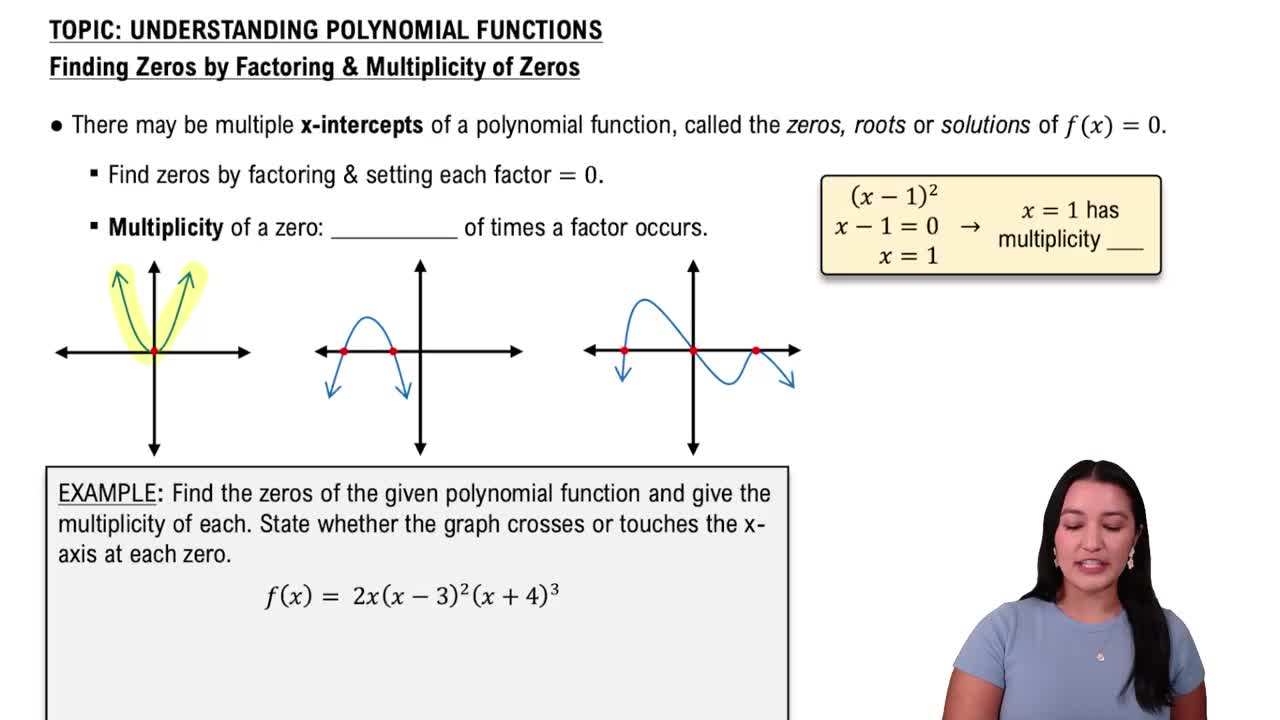
Zeros of a Polynomial Function
The zeros (or roots) of a polynomial are the values of x that make the function equal to zero. They correspond to the x-intercepts on the graph. For the given function, zeros occur where each factor equals zero: x = 0, x = 3, and x = -2.
Recommended video:
Finding Zeros & Their Multiplicity
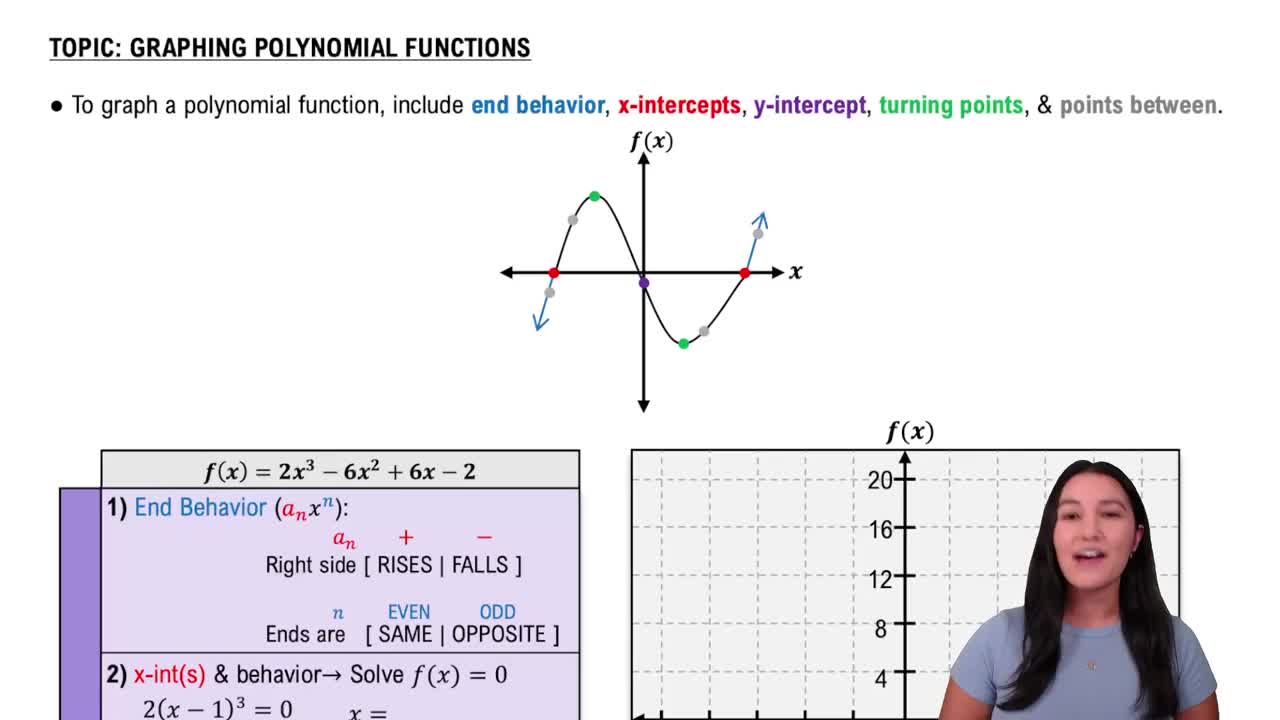
Graphing Polynomial Functions
Graphing involves plotting key points such as zeros and determining the end behavior based on the leading coefficient and degree. The negative leading coefficient (-2) indicates the graph will fall to the right, and the multiplicity of roots affects whether the graph crosses or touches the x-axis at those points.
Recommended video:
Graphing Polynomial Functions
Related Videos
Related Practice
Textbook Question