Graph both equations in the same rectangular coordinate system and find all points of intersection. Then show that these ordered pairs satisfy the equations. (x − 2)²+(y+3)² = 4, y = x - 3
Table of contents
- 0. Review of Algebra4h 18m
- 1. Equations & Inequalities3h 18m
- 2. Graphs of Equations1h 43m
- 3. Functions2h 17m
- 4. Polynomial Functions1h 44m
- 5. Rational Functions1h 23m
- 6. Exponential & Logarithmic Functions2h 28m
- 7. Systems of Equations & Matrices4h 5m
- 8. Conic Sections2h 23m
- 9. Sequences, Series, & Induction1h 22m
- 10. Combinatorics & Probability1h 45m
- Appendix 1. Review of Real Numbers2h 24m
- Appendix 2. Linear Equations and Inequalities3h 42m
- OLD 9. Sequences, Induction, and Probability Coming soon
- 1. - OLD - Fundamental Concepts of Algebra Coming soon
- 2. - OLD - Equations and Inequalities Coming soon
- OLD 4. Rational Functions Coming soon
- OLD 2. Functions & Graphs Coming soon
- OLD 6. Exponential and Logarithmic Functions Coming soon
- OLD 7. Systems of Equations and Inequalities Coming soon
- OLD 8. Matrices and Determinants Coming soon
- OLD 9. Conic Sections Coming soon
3. Functions
Intro to Functions & Their Graphs
Problem 87
Textbook Question
Find a. (f ○ g)(x); b. the domain of (f ○ g). f(x) = (x + 1)/(x - 2), g(x) = 1/x
Verified step by step guidance1
Step 1: Understand that the composition (f \(\circ\) g)(x) means f(g(x)), which is the function f applied to the output of g(x). So, first substitute g(x) into f(x).
Step 2: Write the expression for (f \(\circ\) g)(x) by replacing every x in f(x) with g(x). Since f(x) = \(\frac{x + 1}{x - 2}\) and g(x) = \(\frac{1}{x}\), we have (f \(\circ\) g)(x) = f\(\left\)(\(\frac{1}{x}\)\(\right\)) = \(\frac{\frac{1}{x}\) + 1}{\(\frac{1}{x}\) - 2}.
Step 3: Simplify the complex fraction by finding a common denominator for the numerator and denominator separately, then simplify the overall expression.
Step 4: Determine the domain of (f \(\circ\) g)(x) by considering the domain restrictions of both g(x) and f(g(x)). First, find where g(x) is defined (denominator \(\neq\) 0), then find where f is defined when its input is g(x) (denominator of f(g(x)) \(\neq\) 0).
Step 5: Combine the domain restrictions from both functions to write the domain of (f \(\circ\) g)(x) in interval or set notation, excluding values that make any denominator zero or cause undefined expressions.
Verified video answer for a similar problem:This video solution was recommended by our tutors as helpful for the problem above
Video duration:
3mPlay a video:
0 Comments
Key Concepts
Here are the essential concepts you must grasp in order to answer the question correctly.
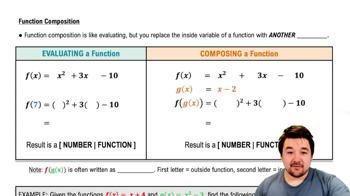
Function Composition
Function composition involves applying one function to the result of another, denoted as (f ○ g)(x) = f(g(x)). It requires substituting the entire output of g(x) into the function f. Understanding this process is essential to correctly find (f ○ g)(x).
Recommended video:
Function Composition
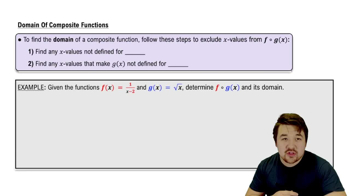
Domain of a Function
The domain of a function is the set of all input values (x) for which the function is defined. When composing functions, the domain of (f ○ g) includes all x-values in the domain of g for which g(x) is in the domain of f. Identifying restrictions like division by zero is crucial.
Recommended video:
Domain Restrictions of Composed Functions
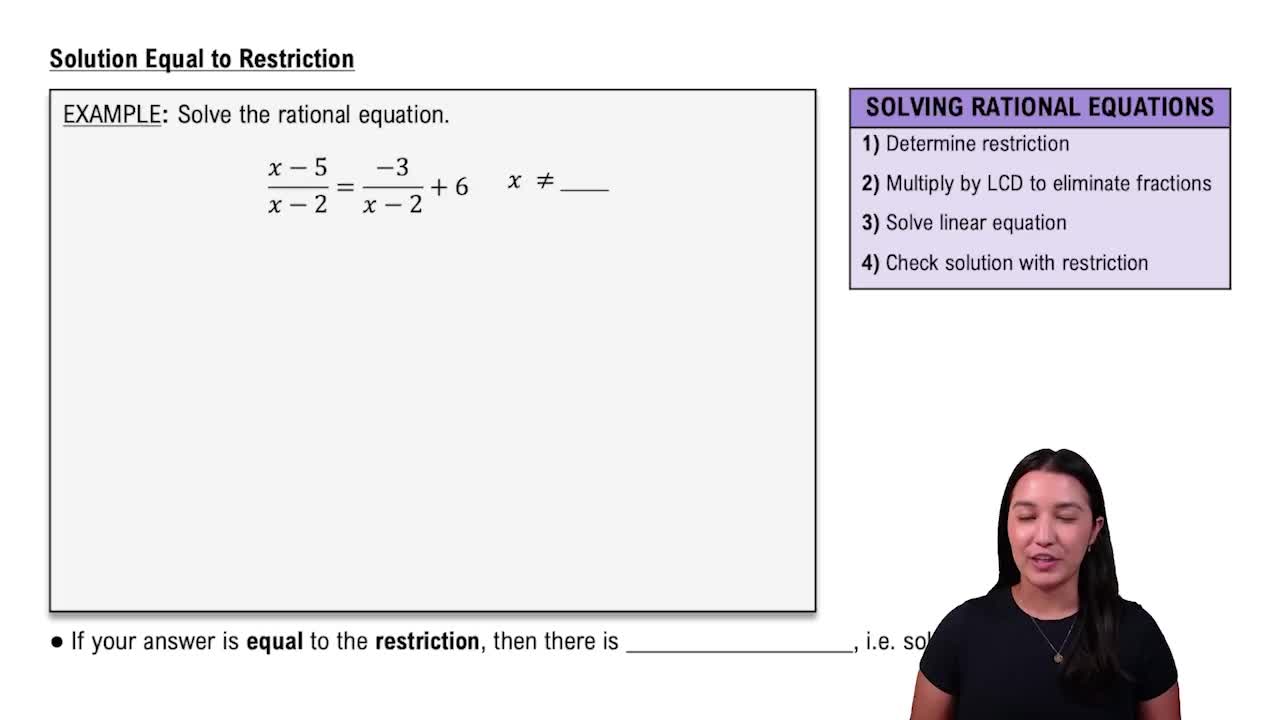
Rational Functions and Restrictions
Rational functions are ratios of polynomials, which can have restrictions where the denominator equals zero. For f(x) = (x + 1)/(x - 2) and g(x) = 1/x, values that make denominators zero must be excluded from the domain to avoid undefined expressions.
Recommended video:
Restrictions on Rational Equations
Related Videos
Related Practice
Textbook Question
2
views