Ch. 7 - Conic Sections
Blitzer - College Algebra 8th Edition
Blitzer8th EditionCollege AlgebraISBN: 9780136970514Not the one you use?Change textbook
Chapter 8, Problem 55

Identify each equation without completing the square. 100x2 - 7y2 + 90y - 368 = 0

Verified step by step guidance
1
Rewrite the given equation to group the terms involving \( y \) together: \( 100x^2 - 7y^2 + 90y - 368 = 0 \).
Focus on the quadratic terms: \( 100x^2 \) and \( -7y^2 \). Notice that the \( x^2 \) term is positive and the \( y^2 \) term is negative, which suggests the equation might represent a hyperbola.
Look at the linear term in \( y \), which is \( 90y \). This term shifts the center of the conic but does not change its fundamental type.
Recall the general forms of conic sections: - Circle: \( Ax^2 + Ay^2 + ... = 0 \) with equal coefficients for \( x^2 \) and \( y^2 \) - Ellipse: \( Ax^2 + By^2 + ... = 0 \) with \( A \) and \( B \) positive and unequal - Hyperbola: \( Ax^2 - By^2 + ... = 0 \) or \( -Ax^2 + By^2 + ... = 0 \) with opposite signs for \( x^2 \) and \( y^2 \) - Parabola: only one squared term
Based on the signs and coefficients of the squared terms, identify the conic as a hyperbola without completing the square.

Verified video answer for a similar problem:

This video solution was recommended by our tutors as helpful for the problem above.
Video duration:
3m

Key Concepts

Here are the essential concepts you must grasp in order to answer the question correctly.

Types of Conic Sections

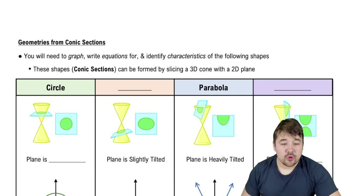
Conic sections are curves obtained by intersecting a plane with a cone, including circles, ellipses, parabolas, and hyperbolas. Each type has a distinct general equation form, and identifying the conic involves analyzing the coefficients of the squared terms and their signs.
Recommended video:
3:08
Geometries from Conic Sections

General Form of a Conic Equation

The general second-degree equation Ax² + Bxy + Cy² + Dx + Ey + F = 0 represents conic sections. By examining coefficients A and C, and the presence or absence of the Bxy term, one can classify the conic without completing the square.
Recommended video:
3:08
Geometries from Conic Sections

Discriminant of a Conic Section

The discriminant, given by B² - 4AC, helps identify the conic type: if it is less than zero, the conic is an ellipse or circle; if zero, a parabola; and if greater than zero, a hyperbola. This method allows classification without rewriting the equation.
Recommended video:
3:08
Geometries from Conic Sections