In Exercises 1–34, solve each rational equation. If an equation has no solution, so state.3/(x+1) = 5/(x−1)
Verified step by step guidance
1
Identify the rational equation: \( \frac{3}{x+1} = \frac{5}{x-1} \).
Cross-multiply to eliminate the fractions: \( 3(x-1) = 5(x+1) \).
Distribute the numbers on both sides: \( 3x - 3 = 5x + 5 \).
Rearrange the equation to isolate terms involving \( x \) on one side: \( 3x - 5x = 5 + 3 \).
Simplify the equation to solve for \( x \).
Verified video answer for a similar problem:
This video solution was recommended by our tutors as helpful for the problem above
Video duration:
4m
Play a video:
0 Comments
Key Concepts
Here are the essential concepts you must grasp in order to answer the question correctly.
Rational Equations
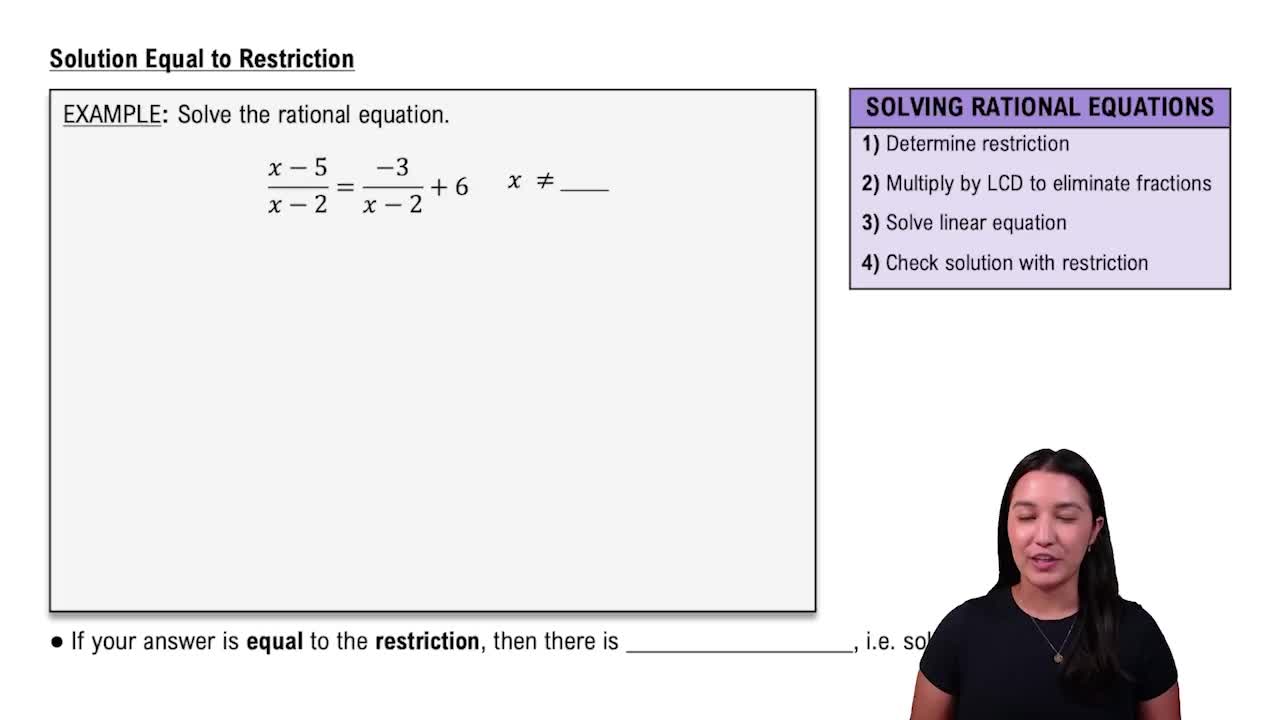
Rational equations are equations that involve fractions with polynomials in the numerator and denominator. To solve these equations, one typically finds a common denominator to eliminate the fractions, allowing for easier manipulation and simplification of the equation. Understanding how to work with rational expressions is crucial for solving these types of equations.
Cross multiplication is a technique used to solve rational equations where two fractions are set equal to each other. By multiplying the numerator of one fraction by the denominator of the other, and vice versa, one can create a simpler equation without fractions. This method is particularly useful in rational equations as it helps to eliminate the denominators and simplifies the solving process.
When solving rational equations, it is essential to check for extraneous solutions, which are solutions that do not satisfy the original equation. This can occur when the process of solving introduces restrictions, such as division by zero. After finding potential solutions, substituting them back into the original equation ensures that they are valid and do not lead to undefined expressions.

 4:11 minutes
 Verified step by step guidance
 05:56
05:56