Use the graphs of f and g to solve Exercises 83–90. Find (fg) (2).
Verified step by step guidance
1
Step 1: Understand the problem. You are tasked with finding (fg)(2), which means you need to evaluate the product of the functions f(x) and g(x) at x = 2.
Step 2: Locate x = 2 on the graph. Look at the horizontal axis and find the point where x = 2.
Step 3: Determine the value of f(2). Find the red graph (representing f(x)) and identify the y-coordinate of the point where x = 2.
Step 4: Determine the value of g(2). Find the blue graph (representing g(x)) and identify the y-coordinate of the point where x = 2.
Step 5: Multiply the values of f(2) and g(2). Once you have the values of f(2) and g(2), multiply them together to find (fg)(2).
Verified video answer for a similar problem:
This video solution was recommended by our tutors as helpful for the problem above
Video duration:
1m
Play a video:
0 Comments
Key Concepts
Here are the essential concepts you must grasp in order to answer the question correctly.
Function Evaluation
Function evaluation involves substituting a specific input value into a function to determine its output. For example, if we have a function f(x), evaluating it at x = 2 means finding f(2). This is essential for solving problems that require specific outputs from given functions.
The product of two functions, denoted as (fg)(x), is defined as the multiplication of their outputs at a given input x. Specifically, (fg)(x) = f(x) * g(x). To find (fg)(2), one must first evaluate f(2) and g(2), then multiply these results together.
Interpreting graphs of functions involves analyzing the visual representation of the functions to extract information such as values at specific points. In this case, the graphs of f(x) and g(x) can be used to find f(2) and g(2) by locating the corresponding y-values at x = 2 on their respective graphs.

 1:20 minutes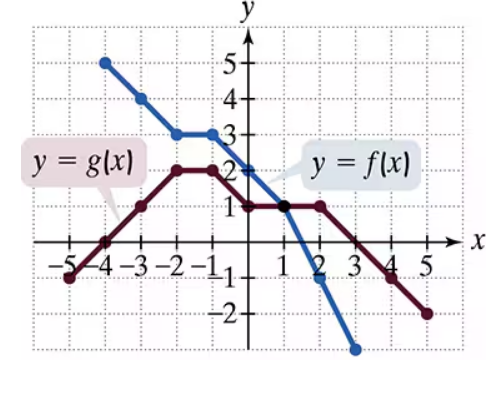
 Verified step by step guidance
 4:26
4:26