In Exercises 39–64, rationalize each denominator.5-------⁴√x
Verified step by step guidance
1
Identify the expression: \( \frac{5}{\sqrt[4]{x}} \). The goal is to rationalize the denominator.
To rationalize \( \sqrt[4]{x} \), multiply both the numerator and the denominator by \( \sqrt[4]{x^3} \) to make the denominator a perfect fourth power.
This gives: \( \frac{5 \cdot \sqrt[4]{x^3}}{\sqrt[4]{x} \cdot \sqrt[4]{x^3}} \).
Simplify the denominator: \( \sqrt[4]{x} \cdot \sqrt[4]{x^3} = \sqrt[4]{x^4} = x \).
The expression becomes: \( \frac{5 \cdot \sqrt[4]{x^3}}{x} \).
Verified video answer for a similar problem:
This video solution was recommended by our tutors as helpful for the problem above
Video duration:
2m
Play a video:
0 Comments
Key Concepts
Here are the essential concepts you must grasp in order to answer the question correctly.
Rationalizing the Denominator
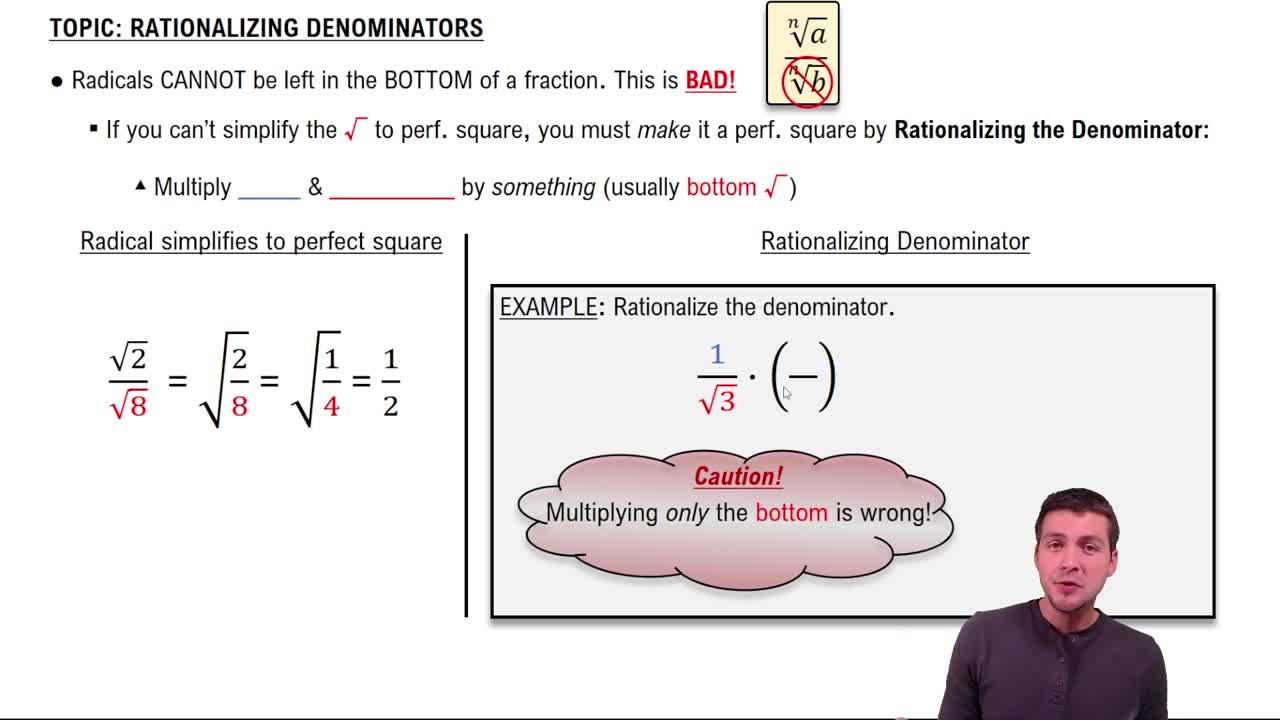
Rationalizing the denominator involves rewriting a fraction so that the denominator is a rational number. This is often necessary when the denominator contains a radical, such as a square root or a higher root. The goal is to eliminate the radical from the denominator, making the expression easier to work with and understand.
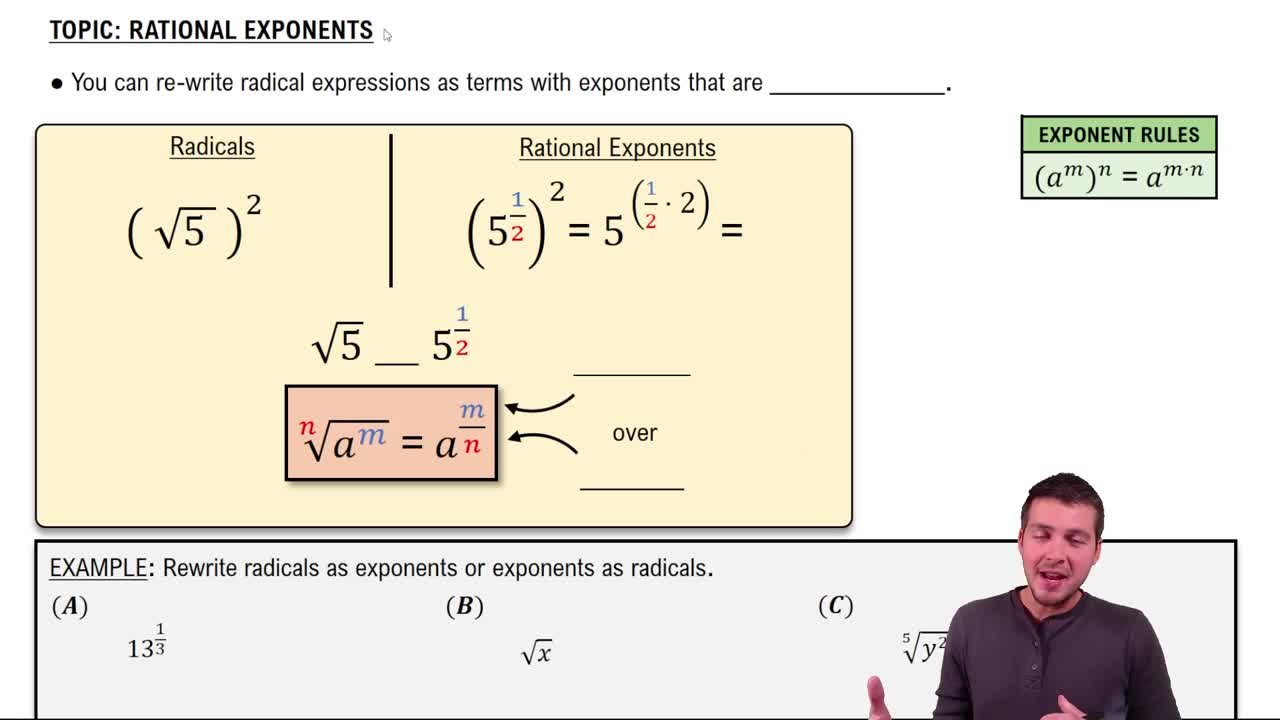
Radicals represent the root of a number, and they can be expressed using exponents. For example, the fourth root of x, denoted as ⁴√x, can be rewritten as x^(1/4). Understanding how to manipulate radicals and their corresponding exponent forms is crucial for simplifying expressions and performing operations involving them.
When rationalizing denominators that contain radicals, one common technique is to multiply the numerator and denominator by the conjugate of the denominator. The conjugate is formed by changing the sign between two terms in a binomial. This method helps eliminate the radical in the denominator by applying the difference of squares formula, resulting in a rational expression.