In Exercises 37–52, perform the indicated operations and write the result in standard form. √-64 - √-25
Ch. 1 - Equations and Inequalities

Chapter 2, Problem 37a
Determine the constant that should be added to the binomial so that it becomes a perfect square trinomial. Then write and factor the trinomial. x2 - 10x
Verified step by step guidance1
Identify the coefficient of the linear term (the term with x). In this case, the coefficient of x is -10.
Divide the coefficient of x by 2. This gives \(-10 \div 2 = -5\).
Square the result from the previous step. \((-5)^2 = 25\). This is the constant that should be added to the binomial to make it a perfect square trinomial.
Add the constant (25) to the binomial \(x^2 - 10x\), resulting in \(x^2 - 10x + 25\).
Factor the trinomial \(x^2 - 10x + 25\) as \((x - 5)^2\), which is the square of a binomial.

Verified video answer for a similar problem:
This video solution was recommended by our tutors as helpful for the problem above.
Video duration:
4mWas this helpful?
Key Concepts
Here are the essential concepts you must grasp in order to answer the question correctly.
Perfect Square Trinomial
A perfect square trinomial is a quadratic expression that can be expressed as the square of a binomial. It takes the form (a ± b)² = a² ± 2ab + b². Recognizing this structure is essential for transforming a given binomial into a perfect square trinomial by adding the appropriate constant.
Recommended video:
Solving Quadratic Equations by Completing the Square
Completing the Square
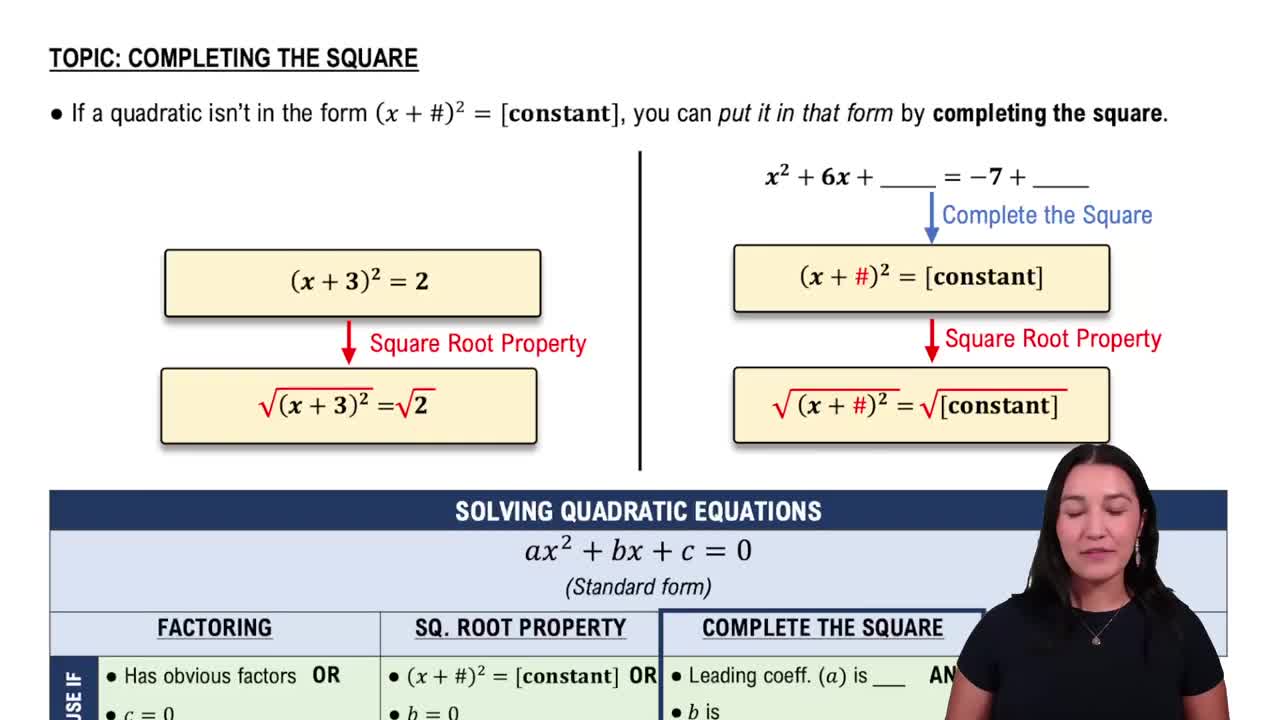
Completing the square is a method used to convert a quadratic expression into a perfect square trinomial. This involves taking half of the coefficient of the linear term, squaring it, and adding it to the expression. This technique is crucial for determining the constant needed to complete the square in the given binomial.
Recommended video:
Solving Quadratic Equations by Completing the Square
Factoring Quadratics
Factoring quadratics involves rewriting a quadratic expression as a product of its linear factors. For a perfect square trinomial, this means expressing it in the form (a ± b)². Understanding how to factor these expressions is important for simplifying and solving quadratic equations effectively.
Recommended video:
Solving Quadratic Equations by Factoring
Related Practice
Textbook Question
Textbook Question
In all exercises, other than exercises with no solution, use interval notation to express solution sets and graph each solution set on a number line. In Exercises 27–50, solve each linear inequality. 2x - 11 < - 3(x + 2)
Textbook Question
Exercises 27–40 contain linear equations with constants in denominators. Solve each equation. 5 + (x - 2)/3 = (x + 3)/8
1
views
Textbook Question
In Exercises 37–52, perform the indicated operations and write the result in standard form. 5√-16 + 3√-81
Textbook Question
Solve each equation with rational exponents in Exercises 31–40. Check all proposed solutions. (x - 4)2/3 = 16
Textbook Question
Solve each formula for the specified variable. Do you recognize the formula? If so, what does it describe? V = (1/3)Bh for B
2
views