Back

Vesicular Budding, Transport, and Coat Proteins definitions

Control buttons has been changed to "navigation" mode.
1/15
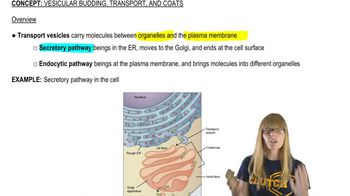
  • Secretory Pathway

    Route moving molecules from the ER through the Golgi to the cell surface, enabling secretion out of the cell.
  • Endocytic Pathway

    Route bringing molecules into the cell from the plasma membrane, directing them to organelles like the Golgi or lysosome.
  • Transport Vesicle

    Small, membrane-enclosed structure shuttling molecules between organelles and the plasma membrane.
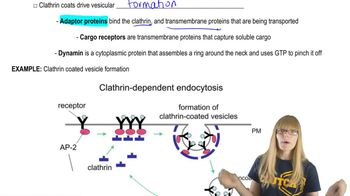
  • Clathrin

    Protein forming a coat around vesicles, especially at the plasma membrane, driving vesicle formation.
  • COP1

    Coat protein mediating vesicle movement from the Golgi toward the ER, involved in inward transport.
  • COP2

    Coat protein responsible for vesicle budding from the ER, facilitating outward transport.
  • Adapter Protein

    Molecule linking coat proteins like clathrin to cargo receptors, ensuring correct cargo selection.
  • Cargo Receptor

    Membrane protein binding specific soluble molecules, enabling their inclusion in forming vesicles.
  • Dynamin

    GTPase forming a ring around vesicle necks, using GTP energy to pinch off budding vesicles.
  • GTPase

    Enzyme regulating coat protein recruitment and vesicle formation by cycling between GDP and GTP states.
  • RAB Protein

    GTPase controlling specificity of vesicle targeting by recruiting appropriate coat proteins to membranes.
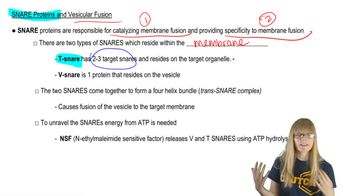
  • SNARE Protein

    Membrane protein mediating vesicle fusion by forming a tight four-helix bundle with target membranes.
  • T-SNARE

    Component residing on target organelles, providing specificity for vesicle fusion events.
  • V-SNARE

    Component located on vesicle membranes, pairing with T-SNAREs to drive membrane fusion.
  • NSF

    ATPase disassembling SNARE complexes after fusion, using ATP hydrolysis to reset the fusion machinery.