Back

The Use of Radioisotopes definitions

Control buttons has been changed to "navigation" mode.
1/14
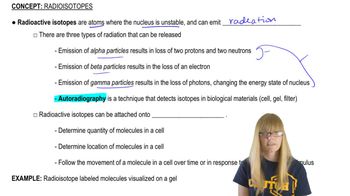
  • Radioisotope

    Unstable atom used to track and analyze molecules in cells by emitting detectable radiation.
  • Radiation

    Energy released from unstable nuclei, detectable as alpha, beta, or gamma particles in experiments.
  • Alpha Particle

    Type of radiation involving the loss of protons and neutrons from an unstable nucleus.
  • Beta Particle

    Radiation form resulting from the emission of electrons during nuclear decay.
  • Gamma Particle

    High-energy photon released from an unstable nucleus, used for molecular detection.
  • Gel

    Material used to separate and analyze molecules, revealing size and type through visible bands.
  • Filter

    Tool for examining proteins, DNA, or molecules by capturing or separating them for analysis.
  • Molecular Tracking

    Technique for following the movement and location of molecules in real time within cells.
  • Quantification

    Process of determining the amount of a specific molecule present in a biological sample.
  • Molecular Dynamics

    Study of changes in molecule behavior, location, or quantity in response to cellular conditions.
  • Protein Analysis

    Examination of proteins using labeled molecules to determine their properties and responses.
  • DNA Analysis

    Investigation of DNA characteristics using labeled isotopes to reveal size, type, or behavior.
  • Photon

    Elementary particle of light energy released during gamma radiation from unstable nuclei.
  • Experimental Setup

    Arrangement of materials and conditions designed to reveal molecular properties using radioisotopes.