Back

Targeting Proteins to the Mitochondria and Chloroplast quiz

Control buttons has been changed to "navigation" mode.
1/15
  • What directs proteins to the mitochondria or chloroplasts?

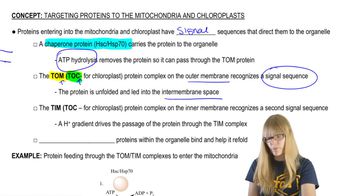
    Specific signal sequences on the proteins direct them to the mitochondria or chloroplasts.
  • What role do chaperone proteins play in targeting proteins to mitochondria or chloroplasts?

    Chaperone proteins recognize signal sequences and help transport proteins to the correct organelle.
  • What energy source is used to release proteins from chaperones upon arrival at the organelle?

    ATP hydrolysis provides the energy to release the protein from the chaperone.
  • Which protein complex do proteins interact with on the outer membrane of mitochondria?

    Proteins interact with the TOM (Translocase of the Outer Membrane) complex on the outer mitochondrial membrane.
  • What is the equivalent of TOM in chloroplasts?

    The equivalent complex in chloroplasts is called TOC (Translocase of the Outer Chloroplast membrane).
  • What happens to proteins as they pass through the TOM or TOC complex?

    Proteins are unfolded and guided into the intermembrane space as they pass through TOM or TOC.
  • What complex do proteins bind to in order to enter the inner membrane of mitochondria?

    Proteins bind to the TIM (Translocase of the Inner Membrane) complex to enter the inner mitochondrial membrane.
  • What is the inner membrane translocase complex called in chloroplasts?

    In chloroplasts, the inner membrane translocase complex is called TIC (Translocase of the Inner Chloroplast membrane).
  • What energy source is required for proteins to pass through the TIM or TIC complex?

    A hydrogen gradient provides the energy needed for proteins to pass through the TIM or TIC complex.
  • What do chaperone proteins do once the protein is inside the organelle?

    Chaperone proteins assist in refolding the transported protein into its functional conformation.
  • How are proteins directed to specific subcompartments within mitochondria or chloroplasts?

    Unique signal sequences target proteins to specific subcompartments like cristae or thylakoids.
  • What is required for a protein to be inserted into a membrane within mitochondria or chloroplasts?

    Start and stop transfer sequences are required for membrane insertion, similar to plasma membrane protein insertion.
  • What happens to the start transfer sequence after membrane insertion?

    The start transfer sequence is cleaved, leaving a single-pass transmembrane protein in the membrane.
  • Can proteins be targeted to both the internal space and membranes of mitochondria or chloroplasts?

    Yes, proteins can be targeted to internal spaces or specific membranes within these organelles.
  • What is the main similarity between protein targeting to mitochondria/chloroplasts and the ER or Golgi?

    All use specific signal sequences to direct proteins to their correct locations.