Skip to main content
Cell Biology
My Course
Learn
Exam Prep
AI Tutor
Study Guides
Flashcards
Explore
Try the app
My Course
Learn
Exam Prep
AI Tutor
Study Guides
Flashcards
Explore
Try the app
Back
Signaling in Plants quiz
You can tap to flip the card.
What is the predominant class of receptor kinases in plants?
You can tap to flip the card.
👆
What is the predominant class of receptor kinases in plants?
Serine/Threonine Kinases are the predominant class of receptor kinases in plants.
Track progress
Control buttons has been changed to "navigation" mode.
1/15
Related flashcards
Related practice
Recommended videos
Signaling in Plants definitions
Signaling in Plants
14 Terms
Signaling in Plants
14. Cell Signaling
7 problems
Topic
Integration of Multiple Signaling Pathways
14. Cell Signaling
7 problems
Topic
14. Cell Signaling - Part 1 of 2
4 topics
12 problems
Chapter
14. Cell Signaling - Part 2 of 2
4 topics
12 problems
Chapter
Guided course
01:49
Plant Signaling
3
views
Terms in this set (15)
Hide definitions
What is the predominant class of receptor kinases in plants?
Serine/Threonine Kinases are the predominant class of receptor kinases in plants.
Which class of receptor kinases is most common in animals?
Tyrosine Kinases are the most common class of receptor kinases in animals.
Do plants have homologs for the JAK-STAT signaling pathway?
No, plants do not have homologs for the JAK-STAT signaling pathway.
Name two key plant-specific signaling molecules mentioned in the lesson.
Auxins and ethylene are two key plant-specific signaling molecules.
What is the main function of auxins in plants?
Auxins stimulate plant growth.
What process does ethylene promote in plants?
Ethylene promotes fruit ripening in plants.
Are Notch, Wnt, and Hedgehog signaling pathways found in plants?
No, Notch, Wnt, and Hedgehog signaling pathways are not found in plants.
What are some plant signaling molecules involved in besides growth and ripening?
They are involved in stem elongation, cell division, dormancy, and light sensing.
Why is signaling in plants discussed separately from animals?
Because signaling mechanisms evolved differently in plants compared to animals.
Do plants have receptor kinases similar to animals?
Yes, plants have receptor kinases similar to animals, but the predominant type differs.
Are the signaling molecules for stem elongation and light sensing found in animals?
No, these signaling molecules are specific to plants and not found in animals.
What is a major difference between plant and animal signaling pathways?
Plants lack several key animal signaling pathways and have unique signaling molecules.
What is the importance of light sensing in plant signaling?
Light sensing is crucial for plant functions and is regulated by specific signaling molecules.
Are cell dormancy and division regulated by plant-specific signaling molecules?
Yes, plant-specific signaling molecules regulate cell dormancy and division.
Why might advanced biology students need to learn about Notch, Wnt, and Hedgehog pathways?
Because these are important animal signaling pathways, but they are not present in plants.
 BackBack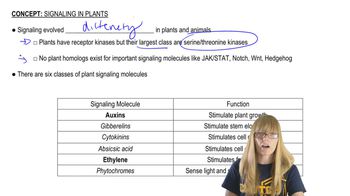
 01:49
01:49