Skip to main content
Cell Biology
My Course
Learn
Exam Prep
AI Tutor
Study Guides
Flashcards
Explore
Try the app
My Course
Learn
Exam Prep
AI Tutor
Study Guides
Flashcards
Explore
Try the app
Back
RNA and the Origins of Life quiz
You can tap to flip the card.
What unique property of RNA allows it to form complex structures necessary for life?
You can tap to flip the card.
👆
What unique property of RNA allows it to form complex structures necessary for life?
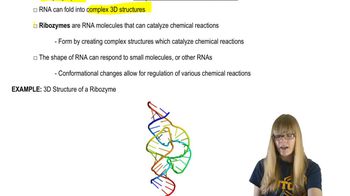
RNA can fold into complex three-dimensional structures, enabling it to perform functions essential for life.
Track progress
Control buttons has been changed to "navigation" mode.
1/15
Related flashcards
Related practice
Recommended videos
RNA and the Origins of Life definitions
RNA and the Origins of Life
15 Terms
RNA and the Origins of Life
5. DNA to RNA to Protein
7 problems
Topic
mRNA Export and Nuclear Structures
5. DNA to RNA to Protein
7 problems
Topic
5. DNA to RNA to Protein - Part 1 of 2
3 topics
9 problems
Chapter
5. DNA to RNA to Protein - Part 2 of 2
3 topics
9 problems
Chapter
Guided course
02:28
Life Requirements
1
views
Guided course
03:22
Evolution of RNA
2
views
Guided course
03:04
Properties of RNA
1
views
Terms in this set (15)
Hide definitions
What unique property of RNA allows it to form complex structures necessary for life?
RNA can fold into complex three-dimensional structures, enabling it to perform functions essential for life.
What are ribozymes and why are they important in the context of the origins of life?
Ribozymes are RNA molecules that catalyze chemical reactions, suggesting RNA could have played a key role in early life.
How does RNA's ability to change shape contribute to its function in early life forms?
RNA can change its three-dimensional structure when bound to small molecules or other RNAs, allowing it to respond to environmental signals.
Why is RNA believed to have predated DNA and proteins?
RNA's ability to store information, catalyze reactions, and respond to its environment suggests it came before DNA and proteins.
What requirement must a molecule meet to be considered responsible for the origination of life?
It must be able to store information for heredity and catalyze chemical reactions necessary for life.
How does RNA store genetic information?
RNA forms polynucleotide chains whose sequence of bases determines its structure and function.
What is the role of ribosomes in modern cells that reflects RNA's evolutionary history?
Ribosomes, which contain rRNA, catalyze protein synthesis and are remnants of RNA's catalytic role in early evolution.
What are the three phases in the history of life according to the RNA world hypothesis?
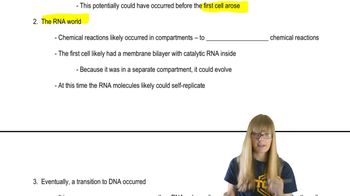
The three phases are the pre-RNA world, the RNA world, and the DNA world.
What characterized the pre-RNA world?
It consisted of simpler RNA-like molecules capable of catalyzing reactions before true RNA existed.
How did the RNA world differ from the pre-RNA world?
In the RNA world, RNA dominated and catalyzed reactions within primitive cellular compartments.
What was likely the only component inside the first primitive cell membrane during the RNA world?
Catalytic RNAs were likely the only molecules inside the early cell membrane bilayer.
Why was compartmentalization important in the RNA world?
Compartmentalization allowed chemical reactions to occur separately, facilitating the evolution of more complex cells.
What property did RNA molecules need to have once they were inside membrane compartments?
RNA molecules needed to be able to self-replicate to continue their existence.
Why did DNA eventually replace RNA as the primary genetic material?
DNA is more stable and efficient at storing genetic information than RNA.
What is a major difference in the complexity of producing DNA versus RNA?
Deoxyribose, the sugar in DNA, is more complicated to make than the ribose found in RNA.
 BackBack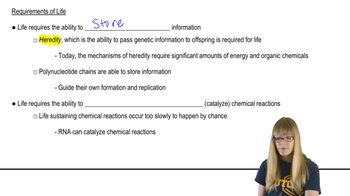
 02:28
02:28