Skip to main content
Cell Biology
My Course
Learn
Exam Prep
AI Tutor
Study Guides
Flashcards
Explore
Try the app
My Course
Learn
Exam Prep
AI Tutor
Study Guides
Flashcards
Explore
Try the app
Back
Packaging of DNA definitions
You can tap to flip the card.
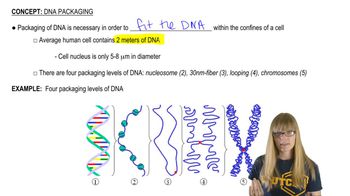
Nucleosome
You can tap to flip the card.
👆
Nucleosome
Basic DNA packaging unit, consisting of DNA wrapped around a core of eight histone proteins, protecting DNA from enzymatic degradation.
Track progress
Control buttons has been changed to "navigation" mode.
1/16
Related flashcards
Related practice
Recommended videos
Packaging of DNA quiz #1
Packaging of DNA
10 Terms
Packaging of DNA
4. DNA, Chromosomes, and Genomes
7 problems
Topic
The Epigenetic Code
4. DNA, Chromosomes, and Genomes
7 problems
Topic
4. DNA, Chromosomes, and Genomes - Part 1 of 2
5 topics
14 problems
Chapter
4. DNA, Chromosomes, and Genomes - Part 2 of 2
5 topics
13 problems
Chapter
Guided course
02:45
Conservation of DNA Packaging
1
views
Guided course
02:30
Unusual Chromatin Structures
2
views
Guided course
01:19
DNA Packaging Overview
2
views
Terms in this set (16)
Hide definitions
Nucleosome
Basic DNA packaging unit, consisting of DNA wrapped around a core of eight histone proteins, protecting DNA from enzymatic degradation.
Histone
Positively charged protein family that binds DNA, facilitating compaction and organization into higher-order structures.
Chromatin
Complex of DNA, associated proteins, and RNA, forming the substance of chromosomes and existing in varying degrees of condensation.
Chromosome
Highly organized structure of condensed chromatin, visible during cell division, containing genes and essential regulatory regions.
Centromere
Specialized repetitive DNA region joining sister chromatids, serving as the assembly site for kinetochore proteins.
Kinetochore
Protein complex assembled on the centromere, providing attachment points for spindle fibers during chromosome segregation.
Telomere
Repetitive DNA sequence at chromosome ends, safeguarding coding regions from degradation during replication.
Chromatin Fiber
30-nanometer zigzag structure formed by nucleosomes linked by H1 histone, representing a higher level of DNA compaction.
DNA Looping
Structural organization where large DNA segments are anchored by non-histone proteins, further condensing chromatin.
Karyotype
Ordered visual display of an organism’s complete set of chromosomes, used to analyze chromosomal number and structure.
Homologous Pair
Set of two chromosomes, one from each parent, carrying the same genes but possibly different alleles, found in diploid organisms.
Histone Variant
Specialized form of histone protein with unique functions, often replacing canonical histones in specific chromosomal regions.
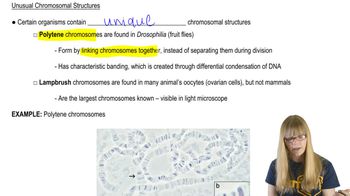
Polytene Chromosome
Giant chromosome with visible banding patterns, formed by repeated rounds of DNA replication without cell division, seen in fruit flies.
Lampbrush Chromosome
Exceptionally large chromosome with extended loops, easily visible under light microscopy, typically found in oocyte nuclei.
Interphase Chromosome
Less condensed chromatin state present when the cell is not dividing, making individual chromosomes indistinct under a microscope.
Metaphase Chromosome
Highly condensed, X-shaped chromatin structure visible during cell division, facilitating accurate segregation.
 BackBack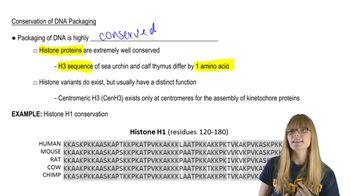
 02:45
02:45