Skip to main content
Cell Biology
My Course
Learn
Exam Prep
AI Tutor
Study Guides
Flashcards
Explore
Try the app
My Course
Learn
Exam Prep
AI Tutor
Study Guides
Flashcards
Explore
Try the app
Back
Overview of Signaling Molecules definitions
You can tap to flip the card.
Extracellular Signaling Molecule
You can tap to flip the card.
👆
Extracellular Signaling Molecule
A chemical messenger released by one cell to communicate with another, coordinating activities in multicellular organisms.
Track progress
Control buttons has been changed to "navigation" mode.
1/15
Related flashcards
Related practice
Recommended videos
Overview of Signaling Molecules quiz #1
Overview of Signaling Molecules
11 Terms
Overview of Signaling Molecules
14. Cell Signaling
7 problems
Topic
G Protein Coupled Receptors
14. Cell Signaling
7 problems
Topic
14. Cell Signaling - Part 1 of 2
4 topics
12 problems
Chapter
14. Cell Signaling - Part 2 of 2
4 topics
12 problems
Chapter
Guided course
12:04
Types of Molecules
2
views
Guided course
04:54
Cell Response
3
views
Terms in this set (15)
Hide definitions
Extracellular Signaling Molecule
A chemical messenger released by one cell to communicate with another, coordinating activities in multicellular organisms.
Steroid Hormone
A lipid-based messenger capable of diffusing through membranes and binding nuclear receptors to regulate gene expression.
Nuclear Receptor
A protein inside the nucleus that binds lipid-soluble messengers, triggering gene transcription.
Nitric Oxide
A gaseous messenger that diffuses rapidly across membranes, influencing blood vessel dilation and blood pressure.
Neurotransmitter
A chemical messenger released by neurons to transmit signals across synapses to other neurons or target cells.
Peptide Hormone
A protein-based messenger that binds to plasma membrane receptors, unable to cross the lipid bilayer directly.
Growth Factor
A protein signal that binds cell surface receptors to regulate cell growth, division, or differentiation.
Eicosanoid
A lipid-derived messenger that binds membrane receptors, modulating immune responses like inflammation and fever.
Plasma Membrane Receptor
A cell surface protein that binds extracellular messengers, initiating intracellular signaling cascades.
Endocrine Signal
A long-distance chemical message transported via the bloodstream to affect distant target cells.
Paracrine Signal
A local chemical message acting on neighboring cells within the same tissue.
Autocrine Signal
A self-targeted chemical message produced and received by the same cell for self-regulation.
Second Messenger
An intracellular molecule activated by a receptor, relaying and amplifying signals within the cell.
Signal Transduction
The process of converting an extracellular message into an intracellular response through a series of molecular events.
Signaling Cascade
A sequential activation of multiple proteins, amplifying and distributing a cellular message for a robust response.
 BackBack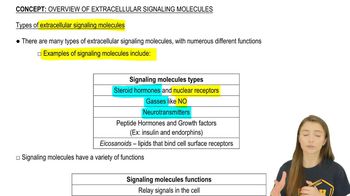
 12:04
12:04