Skip to main content
Cell Biology
My Course
Learn
Exam Prep
AI Tutor
Study Guides
Flashcards
Explore
Try the app
My Course
Learn
Exam Prep
AI Tutor
Study Guides
Flashcards
Explore
Try the app
Back
Overview of Photosynthesis definitions
You can tap to flip the card.
Photosynthesis
You can tap to flip the card.
👆
Photosynthesis
Process in plants converting light energy into chemical energy, producing ATP, NADPH, and sugars while releasing oxygen.
Track progress
Control buttons has been changed to "navigation" mode.
1/13
Related flashcards
Related practice
Recommended videos
Overview of Photosynthesis quiz #1
Overview of Photosynthesis
10 Terms
Overview of Photosynthesis
12. Photosynthesis
7 problems
Topic
Chloroplast
12. Photosynthesis
7 problems
Topic
12. Photosynthesis
4 topics
12 problems
Chapter
Guided course
03:47
Overview
4
views
Terms in this set (13)
Hide definitions
Photosynthesis
Process in plants converting light energy into chemical energy, producing ATP, NADPH, and sugars while releasing oxygen.
Light-dependent reactions
Stage using chlorophyll to absorb light, driving ATP and NADPH production through an electron transport chain.
Calvin cycle
Series of reactions using ATP and NADPH to fix carbon dioxide into a 3-carbon sugar, enabling glucose synthesis.
Chlorophyll
Pigment in plant cells responsible for absorbing light energy to initiate the process of ATP synthesis.
ATP
Molecule generated during light-dependent reactions, serving as the main energy currency for cellular processes.
NADPH
Electron carrier produced in light-dependent reactions, providing reducing power for carbon fixation in plants.
Photophosphorylation
Mechanism where light energy drives ATP synthesis via an electron transport chain in chloroplasts.
Electron transport chain
Series of protein complexes transferring electrons to generate a proton gradient for ATP production.
Carbon fixation
Process incorporating inorganic carbon dioxide into organic molecules during the Calvin cycle.
Oxygen
Byproduct released during photosynthesis, essential for supporting aerobic respiration in living organisms.
Glucose
Six-carbon sugar synthesized from smaller sugars produced in the Calvin cycle, serving as a primary energy source.
3-carbon sugar
Initial carbohydrate product of the Calvin cycle, later used to build larger sugars like glucose.
NAD+
Molecule reduced to NADPH during light-dependent reactions, acting as an electron acceptor in plants.
 BackBack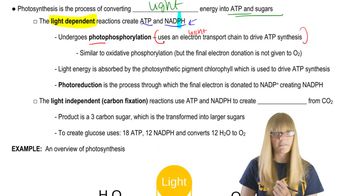
 03:47
03:47