Skip to main content
Cell Biology
My Course
Learn
Exam Prep
AI Tutor
Study Guides
Flashcards
Explore
Try the app
My Course
Learn
Exam Prep
AI Tutor
Study Guides
Flashcards
Explore
Try the app
Back
Overview of Host Defenses definitions
You can tap to flip the card.
Pathogen
You can tap to flip the card.
👆
Pathogen
An infectious agent capable of causing disease when entering a host organism.
Track progress
Control buttons has been changed to "navigation" mode.
1/15
Related flashcards
Related practice
Recommended videos
Overview of Host Defenses quiz #1
Overview of Host Defenses
10 Terms
Overview of Host Defenses
21. The Immune System
7 problems
Topic
The Innate Immune Response
21. The Immune System
7 problems
Topic
21. The Immune System - Part 1 of 2
4 topics
11 problems
Chapter
21. The Immune System - Part 2 of 2
4 topics
10 problems
Chapter
Guided course
04:28
Host Defences
3
views
Terms in this set (15)
Hide definitions
Pathogen
An infectious agent capable of causing disease when entering a host organism.
Mechanical Barrier
A physical structure, such as skin, that blocks the entry of infectious agents into the body.
Chemical Barrier
A substance on body surfaces or in secretions that targets and neutralizes infectious agents.
Innate Immune System
A non-specific defense mechanism including barriers and cells that respond rapidly to infections.
Phagocytic Cell
A white blood cell type that engulfs and digests pathogens within the body.
Macrophage
A large phagocytic cell that ingests and breaks down pathogens as part of immune defense.
Complement System
A group of proteins that bind pathogens and mark them for destruction by immune cells.
Inflammation
A localized response involving immune cells to control and eliminate infections.
Adaptive Immune System
A highly specific defense mechanism involving cells that target particular pathogens.
B Cell
A lymphocyte responsible for producing antibodies tailored to specific pathogens.
T Cell
A lymphocyte that destroys infected cells or pathogens through targeted immune responses.
Antibody
A protein produced by certain immune cells that binds specifically to pathogens for neutralization.
Antibody Response
A targeted immune reaction involving the production of proteins that recognize specific pathogens.
White Blood Cell
A cellular component of the immune system involved in defending the body against infections.
Host
An organism, such as a human or animal, that can be invaded by infectious agents.
 BackBack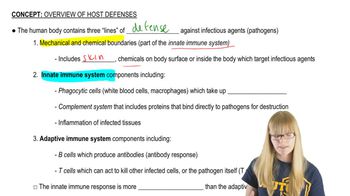
 04:28
04:28