Skip to main content
Cell Biology
My Course
Learn
Exam Prep
AI Tutor
Study Guides
Flashcards
Explore
Try the app
My Course
Learn
Exam Prep
AI Tutor
Study Guides
Flashcards
Explore
Try the app
Back
Overview of Cell Surface Receptors definitions
You can tap to flip the card.
Ion Channel Coupled Receptor
You can tap to flip the card.
👆
Ion Channel Coupled Receptor
Membrane protein that responds to ion gradients, converting chemical signals into electrical ones, crucial for nerve signaling.
Track progress
Control buttons has been changed to "navigation" mode.
1/15
Related flashcards
Related practice
Recommended videos
Overview of Cell Surface Receptors quiz #1
Overview of Cell Surface Receptors
14 Terms
Overview of Cell Surface Receptors
14. Cell Signaling
7 problems
Topic
Overview of Signaling Molecules
14. Cell Signaling
7 problems
Topic
14. Cell Signaling - Part 1 of 2
4 topics
12 problems
Chapter
14. Cell Signaling - Part 2 of 2
4 topics
12 problems
Chapter
Guided course
07:35
Cell Surface Receptors
4
views
Terms in this set (15)
Hide definitions
Ion Channel Coupled Receptor
Membrane protein that responds to ion gradients, converting chemical signals into electrical ones, crucial for nerve signaling.
G Protein-Coupled Receptor
Membrane protein that, upon activation, triggers cytosolic G proteins, initiating a signaling cascade affecting various cellular targets.
Enzyme-Coupled Receptor
Membrane protein with a cytosolic domain acting as an enzyme, often forming dimers and initiating intracellular signaling upon activation.
Ligand
Extracellular molecule that binds to a receptor, triggering its activation and subsequent intracellular signaling events.
Protein Kinase
Enzyme that adds phosphate groups to proteins, modulating their activity during signal transduction pathways.
Phosphatase
Enzyme that removes phosphate groups from proteins, counteracting kinases and regulating protein function in signaling.
Second Messenger
Small molecule generated downstream of receptor activation, propagating and amplifying intracellular signals.
Signal Transduction Pathway
Series of molecular events where activated proteins sequentially relay and amplify signals, often ending in gene regulation.
Transcription Factor
Protein activated at the end of signaling cascades, entering the nucleus to modulate gene expression.
Downregulation
Cellular process where receptors are removed from the plasma membrane to decrease sensitivity to persistent external signals.
Dimer
Complex formed by two receptor molecules, commonly seen in enzyme-coupled receptor activation.
Cytosol
Intracellular fluid where G proteins and other signaling molecules operate following receptor activation.
Gene Expression
Process influenced by signaling pathways, resulting in the activation or inhibition of specific genes.
Proliferation
Cellular outcome regulated by signaling pathways, involving an increase in cell number through division.
Apoptosis
Programmed cell death, which can be triggered by specific signaling cascades initiated at the cell surface.
 BackBack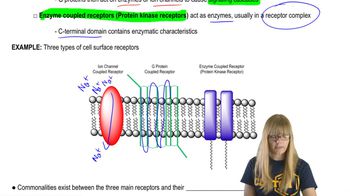
 07:35
07:35