Skip to main content
Cell Biology
My Course
Learn
Exam Prep
AI Tutor
Study Guides
Flashcards
Explore
Try the app
My Course
Learn
Exam Prep
AI Tutor
Study Guides
Flashcards
Explore
Try the app
Back
Overview of Cancer definitions
You can tap to flip the card.
Tumor
You can tap to flip the card.
👆
Tumor
A mass of cells formed from excessive and uncontrolled cell division, often resulting in abnormal tissue growth.
Track progress
Control buttons has been changed to "navigation" mode.
1/18
Related flashcards
Related practice
Recommended videos
Overview of Cancer quiz #1
Overview of Cancer
10 Terms
Overview of Cancer
20. Cancer
7 problems
Topic
Oncogenes and Tumor Suppressors
20. Cancer
7 problems
Topic
20. Cancer - Part 1 of 2
3 topics
9 problems
Chapter
20. Cancer - Part 2 of 2
3 topics
9 problems
Chapter
Guided course
08:30
Overview of Cancer
5
views
Terms in this set (18)
Hide definitions
Tumor
A mass of cells formed from excessive and uncontrolled cell division, often resulting in abnormal tissue growth.
Benign
A localized abnormal cell mass that does not invade nearby tissues or spread to distant sites.
Malignant
A type of abnormal cell mass that invades surrounding tissues and can spread to distant organs.
Metastasis
The process by which abnormal cells spread from their original site to distant organs or tissues.
Carcinoma
A cancer originating from epithelial cells, representing the majority of human cancers.
Leukemia
A cancer arising from blood-forming tissues, leading to abnormal proliferation of blood cells.
Lymphoma
A cancer derived from immune system cells, particularly lymphocytes, affecting lymphatic tissues.
Sarcoma
A rare cancer type originating from connective tissues such as bone, muscle, or fat.
Carcinogen
A substance or agent, like tobacco, known to induce genetic changes leading to abnormal cell growth.
Epidemiology
A scientific field focused on studying disease patterns and causes within human populations.
Mutation
A permanent alteration in DNA sequence that can disrupt normal cell regulation and contribute to disease.
Oncogene
A mutated gene variant that actively promotes uncontrolled cell proliferation and tumor development.
Proto-oncogene
A normal gene that, when altered, has the potential to become a driver of abnormal cell growth.
Tumor suppressor gene
A gene responsible for restraining cell division, whose loss of function can lead to unchecked growth.
Angiogenesis
The formation of new blood vessels within abnormal tissue masses to supply nutrients and oxygen.
Apoptosis
A regulated process of programmed cell death, often defective in abnormal cell masses.
Contact inhibition
A cellular property where division stops upon contact with neighboring cells, lost in abnormal growths.
Genetic instability
A state where cells rapidly accumulate DNA changes, increasing the likelihood of abnormal growth.
 BackBack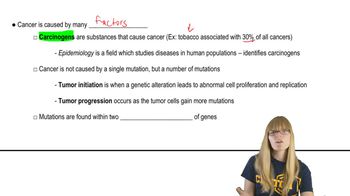
 08:30
08:30