Skip to main content
Cell Biology
My Course
Learn
Exam Prep
AI Tutor
Study Guides
Flashcards
Explore
Try the app
My Course
Learn
Exam Prep
AI Tutor
Study Guides
Flashcards
Explore
Try the app
Back
Oncogenes and Tumor Suppressors definitions
You can tap to flip the card.
Oncogene
You can tap to flip the card.
👆
Oncogene
A mutated gene with increased expression that drives cell proliferation, survival, and tumor formation.
Track progress
Control buttons has been changed to "navigation" mode.
1/15
Related flashcards
Related practice
Recommended videos
Oncogenes and Tumor Suppressors quiz #1
Oncogenes and Tumor Suppressors
10 Terms
Oncogenes and Tumor Suppressors
20. Cancer
7 problems
Topic
Carcinogens
20. Cancer
7 problems
Topic
20. Cancer - Part 1 of 2
3 topics
9 problems
Chapter
20. Cancer - Part 2 of 2
3 topics
9 problems
Chapter
Guided course
07:25
Oncogenes and Tumor Suppressors
8
views
Terms in this set (15)
Hide definitions
Oncogene
A mutated gene with increased expression that drives cell proliferation, survival, and tumor formation.
Tumor Suppressor
A gene whose loss of function removes cellular restraints, enabling uncontrolled division and mutation accumulation.
Proto-oncogene
A normal gene that, when mutated or overexpressed, can become a driver of cancerous growth.
RAS
A GTPase frequently mutated in cancers, leading to persistent activation of growth-promoting pathways.
p53
A transcription factor that senses DNA damage and normally halts cell division or triggers repair.
Retinoblastoma
A cell cycle regulator whose mutation can be inherited and leads to loss of cell cycle control.
Apoptosis
A programmed cell death process that is evaded by cancer cells, allowing their survival.
Angiogenesis
The formation of new blood vessels, supplying tumors with nutrients and oxygen for growth.
Metastasis
The spread of cancer cells from the original site to distant tissues, forming secondary tumors.
Genetic Instability
A state where cells rapidly accumulate mutations, fueling cancer progression.
Growth Factor
A signaling molecule that, when overexpressed, stimulates excessive cell division in tumors.
Transcription Factor
A protein that regulates gene expression; its overactivity can drive abnormal cell behavior.
GTP Binding Protein
A molecular switch involved in signaling; its dysregulation can promote cancerous activity.
Cell Cycle
The sequence of events leading to cell division, often deregulated in cancer cells.
DNA Damage Repair
A cellular process for fixing genetic errors, often impaired in cancer, leading to mutation buildup.
 BackBack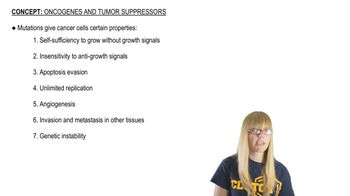
 07:25
07:25