Skip to main content
Cell Biology
My Course
Learn
Exam Prep
AI Tutor
Study Guides
Flashcards
Explore
Try the app
My Course
Learn
Exam Prep
AI Tutor
Study Guides
Flashcards
Explore
Try the app
Back
Meiosis definitions
You can tap to flip the card.
Meiosis
You can tap to flip the card.
👆
Meiosis
Cell division process generating four genetically unique haploid cells from one diploid cell, essential for sexual reproduction.
Track progress
Control buttons has been changed to "navigation" mode.
1/17
Related flashcards
Related practice
Recommended videos
Meiosis quiz #1
Meiosis
40 Terms
Meiosis quiz #2
Meiosis
32 Terms
Meiosis
17. Meiosis and Sexual Reproduction
7 problems
Topic
Mendel and the Laws of Inheritance
17. Meiosis and Sexual Reproduction
7 problems
Topic
17. Meiosis and Sexual Reproduction
3 topics
9 problems
Chapter
Guided course
06:05
Overview of Meiosis
3
views
Guided course
05:25
Meiosis Steps
2
views
Guided course
04:28
Genetic Variation
4
views
Terms in this set (17)
Hide definitions
Meiosis
Cell division process generating four genetically unique haploid cells from one diploid cell, essential for sexual reproduction.
Haploid
Cell state containing a single set of chromosomes, half the genetic content of the original diploid cell.
Diploid
Cell state with two complete sets of chromosomes, one from each parent, typical of somatic cells.
Germ Cell
Specialized cell type that undergoes meiosis to produce gametes for sexual reproduction.
Sister Chromatid
Identical DNA copies formed by replication of a chromosome, joined together until separated during cell division.
Homologous Chromosome
Pair of chromosomes, one maternal and one paternal, carrying the same genes but possibly different alleles.
Bivalent
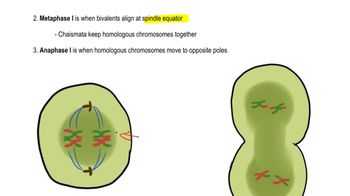
Structure formed when two homologous chromosomes align and pair during prophase I, enabling genetic exchange.
Tetrad
Group of four chromatids formed by the pairing of two homologous chromosomes during meiosis I.
Crossing Over
Physical exchange of chromosomal segments between maternal and paternal homologs, increasing genetic diversity.
Chiasmata
Visible points where homologous chromosomes remain connected after crossing over, ensuring proper alignment.
Homologous Recombination
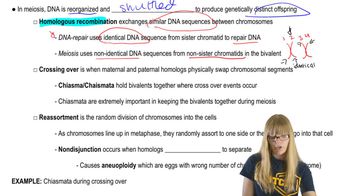
Process where similar but non-identical DNA sequences are exchanged between non-sister chromatids in meiosis.
Reassortment
Random distribution of chromosomes into gametes, contributing to genetic variation among offspring.
Nondisjunction
Failure of homologous chromosomes or sister chromatids to separate, resulting in abnormal chromosome numbers.
Aneuploidy
Condition where gametes or cells have an abnormal number of chromosomes, often leading to genetic disorders.
Gametic Meiosis
Type of meiosis where gametes are produced directly, typical in animals, with fertilization restoring diploidy.
Zygotic Meiosis
Meiotic process occurring after fertilization, producing haploid spores; common in some non-animal organisms.
Sporic Meiosis
Meiotic process unrelated to gamete formation, producing spores that develop into gametophytes via mitosis.
 BackBack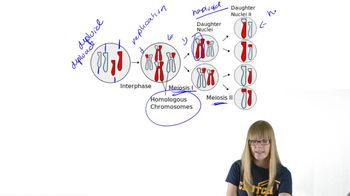
 06:05
06:05