Skip to main content
Cell Biology
My Course
Learn
Exam Prep
AI Tutor
Study Guides
Flashcards
Explore
Try the app
My Course
Learn
Exam Prep
AI Tutor
Study Guides
Flashcards
Explore
Try the app
Back
Kinesins and Dyneins definitions
You can tap to flip the card.
Kinesin
You can tap to flip the card.
👆
Kinesin
A motor protein that transports cargo toward the plus end of microtubules, moving materials away from the nucleus toward the plasma membrane.
Track progress
Control buttons has been changed to "navigation" mode.
1/15
Related flashcards
Related practice
Recommended videos
Kinesins and Dyneins quiz
Kinesins and Dyneins
15 Terms
Kinesins and Dyneins
15. Cytoskeleton and Cell Movement
7 problems
Topic
Cilia and Flagella
15. Cytoskeleton and Cell Movement
7 problems
Topic
15. Cytoskeleton and Cell Movement - Part 1 of 2
5 topics
14 problems
Chapter
15. Cytoskeleton and Cell Movement - Part 2 of 2
5 topics
13 problems
Chapter
Guided course
05:57
Kinesins and Dyneins
5
views
Terms in this set (15)
Hide definitions
Kinesin
A motor protein that transports cargo toward the plus end of microtubules, moving materials away from the nucleus toward the plasma membrane.
Dynein
A motor protein responsible for moving cargo toward the minus end of microtubules, directing materials toward the cell nucleus.
Microtubule
A cytoskeletal filament serving as a track for directional movement of motor proteins within the cell.
Motor Protein
A protein that uses ATP hydrolysis to generate force and transport cellular cargo along cytoskeletal filaments.
ATP Hydrolysis
A chemical reaction providing energy for motor proteins to move by converting ATP to ADP.
Dimeric Structure
A molecular arrangement consisting of two subunits, often forming the functional unit of motor proteins.
Cargo
Any molecule or organelle transported by motor proteins along microtubules within the cell.
Plus End
The growing end of a microtubule, typically oriented toward the cell periphery and targeted by kinesins.
Minus End
The anchored end of a microtubule, usually located near the cell nucleus and approached by dyneins.
Processive Movement
A type of motion where a motor protein travels long distances along a microtubule without detaching.
Tail Domain
The region of a motor protein that binds to and carries cellular cargo during transport.
Head Domain
The region of a motor protein that attaches to microtubules and catalyzes ATP hydrolysis for movement.
Dynactin
A protein complex that interacts with dynein to enhance its attachment and cargo-carrying efficiency.
Kinesin-1
The most prominent member of its protein family, specialized for transporting cargo toward the cell periphery.
Brownian Movement
Random thermal motion of particles, distinct from the directed transport performed by motor proteins.
 BackBack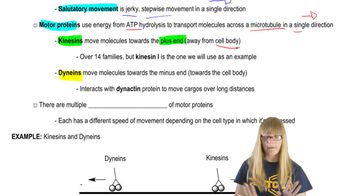
 05:57
05:57