Back

Isolation and Purification of Proteins quiz

Control buttons has been changed to "navigation" mode.
1/15
  • What is the main goal of protein purification?

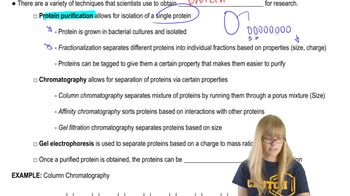
    The main goal is to isolate a single protein from a complex mixture for research and study.
  • From what sources can proteins be extracted for purification?

    Proteins can be extracted from bacteria, cells, organisms, or tissues.
  • What does fractionation mean in the context of protein purification?

    Fractionation refers to separating proteins in a solution based on properties like size, charge, or affinity.
  • How does a fractionation machine separate proteins by size?

    It runs the protein solution through materials that separate proteins, collecting them into different tubes based on their size.
  • Why might scientists tag proteins during purification?

    Tagging proteins can alter their properties, such as size, charge, or affinity, making them easier to separate.
  • What is column chromatography used for in protein purification?

    Column chromatography separates proteins by running them through a porous mixture, sorting them based on size.
  • How does affinity chromatography separate proteins?

    Affinity chromatography separates proteins based on their interactions with other proteins or specific binding partners.
  • What property does gel filtration chromatography use to separate proteins?

    Gel filtration chromatography separates proteins based on their size.
  • What is the principle behind gel electrophoresis in protein purification?

    Gel electrophoresis separates proteins based on their charge-to-mass ratio.
  • Why is it important to study purified proteins in isolation?

    Studying purified proteins in isolation allows scientists to understand the function of a single protein without interference from others.
  • What happens to proteins of the same size during fractionation by size?

    Proteins of the same size will end up in the same fraction or tube.
  • How can tagging help separate proteins of the same size?

    Tagging can change the properties of proteins, such as their size or charge, allowing them to be separated even if they originally had the same size.
  • What is collected in each tube during size-based fractionation?

    Each tube collects proteins of a specific size, such as 5, 10, or 15 kilodaltons.
  • What is the purpose of using different chromatography techniques?

    Different chromatography techniques are used to separate proteins based on different properties, such as size or interactions.
  • What is the outcome after running a protein solution through column chromatography?

    The outcome is that different proteins are collected in separate containers, allowing for their isolation and further study.