Skip to main content
Cell Biology
My Course
Learn
Exam Prep
AI Tutor
Study Guides
Flashcards
Explore
Try the app
My Course
Learn
Exam Prep
AI Tutor
Study Guides
Flashcards
Explore
Try the app
Back
Ion Channels and Neurons definitions
You can tap to flip the card.
Neuron
You can tap to flip the card.
👆
Neuron
Specialized cell with structures for receiving, integrating, and transmitting electrical and chemical signals in the nervous system.
Track progress
Control buttons has been changed to "navigation" mode.
1/15
Related flashcards
Related practice
Recommended videos
Ion Channels and Neurons quiz #1
Ion Channels and Neurons
13 Terms
Ion Channels and Neurons
9. Transport Across Membranes
7 problems
Topic
Ion Channels and Membrane Potential
9. Transport Across Membranes
7 problems
Topic
9. Transport Across Membranes
5 topics
15 problems
Chapter
Guided course
14:49
Action Potentials
2
views
Guided course
07:36
Neuronal Signaling Steps
2
views
Guided course
05:07
Neuron Structure
4
views
Terms in this set (15)
Hide definitions
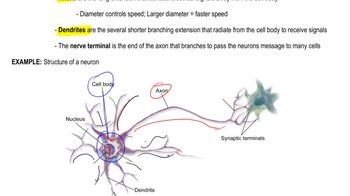
Neuron
Specialized cell with structures for receiving, integrating, and transmitting electrical and chemical signals in the nervous system.
Cell Body
Central region containing the nucleus and metabolic machinery, integrating incoming signals from dendrites.
Axon
Long extension conducting electrical impulses away from the cell body toward other cells or effectors.
Dendrite
Branch-like projections that receive incoming signals from other neurons and transmit them to the cell body.
Myelin Sheath
Insulating covering around axons, formed by glial cells, increasing signal speed and preventing ion leakage.
Node of Ranvier
Gaps in the myelin sheath containing clusters of ion channels, enabling rapid, saltatory conduction of action potentials.
Synapse
Junction between two neurons or a neuron and another cell, where signal transmission occurs.
Synaptic Cleft
Narrow extracellular space separating presynaptic and postsynaptic cells, across which neurotransmitters diffuse.
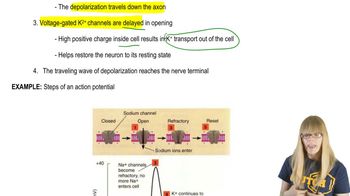
Action Potential
Rapid, non-decremental electrical impulse traveling along the axon, conveying information within the nervous system.
Voltage-Gated Cation Channel
Membrane protein opening in response to voltage changes, allowing influx of positive ions to initiate action potentials.
Potassium Channel
Membrane protein facilitating the efflux of K+ ions, crucial for repolarizing the neuron after depolarization.
Neurotransmitter
Chemical messenger released from nerve terminals, binding to receptors on target cells to modulate their activity.
Excitatory Neurotransmitter
Chemical signal increasing the likelihood of action potential generation in the postsynaptic neuron.
Inhibitory Neurotransmitter
Chemical signal decreasing the likelihood of action potential generation by making depolarization more difficult.
Synaptic Plasticity
Ability of synapses to strengthen or weaken over time, altering neuronal response based on previous activity.
 BackBack
 14:49
14:49