What does Gibbs free energy determine about a chemical reaction?
Gibbs free energy determines if a chemical reaction occurs spontaneously, indicating its thermodynamic favorability.
What is a spontaneous reaction?
A spontaneous reaction is one that is thermodynamically favorable and can occur without outside help.
How does entropy change in a spontaneous reaction?
Entropy increases in a spontaneous reaction, meaning the disorder of the system goes up.
What does a negative delta G (ΔG) indicate about a reaction?
A negative delta G means the reaction is exergonic, releases energy, and is thermodynamically favorable.
How is standard free energy change different from delta G?
Standard free energy change measures spontaneity under standard conditions, while delta G measures it under actual, changing concentrations.
What are the standard conditions for calculating standard free energy change?
Standard conditions are 25°C temperature and 1 atm pressure.
Why do we use standard free energy change to compare reactions instead of delta G?
We use standard free energy change because it allows comparison between reactions by removing the effect of varying concentrations.
What is the difference between exergonic and endergonic reactions?
Exergonic reactions release energy (ΔG negative), while endergonic reactions absorb energy (ΔG positive).
At equilibrium, what is the value of delta G?
At equilibrium, delta G is zero, meaning no net reaction occurs.
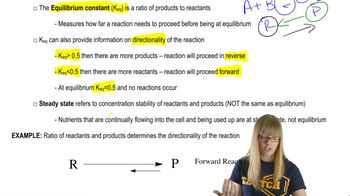
What does the equilibrium constant (K_eq) measure?
The equilibrium constant measures the ratio of products to reactants at equilibrium, indicating reaction directionality.
If K_eq is less than 0.5, in which direction does the reaction proceed?
If K_eq is less than 0.5, the reaction proceeds forward to make more products.
What does it mean if K_eq is greater than 0.5?
If K_eq is greater than 0.5, the reaction proceeds in reverse, making more reactants.
How does steady state differ from equilibrium?
Steady state means concentrations of reactants and products remain stable, but the forward and reverse flows are not equal as in equilibrium.
Can nutrient transport in cells be at steady state but not at equilibrium? Why?
Yes, because concentrations can remain stable without equal flow in and out, so it's steady state but not equilibrium.
Why do cells not exist at equilibrium?
Cells do not exist at equilibrium because life depends on reactions trying to reach equilibrium but not quite getting there, maintaining necessary gradients and processes.
 Back
Back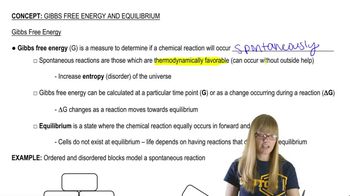
 08:57
08:57