Skip to main content
Cell Biology
My Course
Learn
Exam Prep
AI Tutor
Study Guides
Flashcards
Explore
Try the app
My Course
Learn
Exam Prep
AI Tutor
Study Guides
Flashcards
Explore
Try the app
Back
G Protein Coupled Receptors definitions
You can tap to flip the card.
G Protein Coupled Receptor
You can tap to flip the card.
👆
G Protein Coupled Receptor
Largest family of cell surface receptors, composed of a single polypeptide chain that crosses the membrane seven times.
Track progress
Control buttons has been changed to "navigation" mode.
1/16
Related flashcards
Related practice
Recommended videos
G Protein Coupled Receptors quiz #1
G Protein Coupled Receptors
10 Terms
G Protein Coupled Receptors
14. Cell Signaling
7 problems
Topic
Protein Kinase Receptors
14. Cell Signaling
7 problems
Topic
14. Cell Signaling - Part 1 of 2
4 topics
12 problems
Chapter
14. Cell Signaling - Part 2 of 2
4 topics
12 problems
Chapter
Guided course
06:29
Common Pathways
1
views
Guided course
04:13
Structure and Signaling
1
views
Terms in this set (16)
Hide definitions
G Protein Coupled Receptor
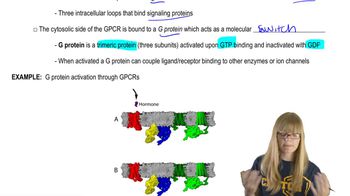
Largest family of cell surface receptors, composed of a single polypeptide chain that crosses the membrane seven times.
G Protein
Trimeric molecular switch activated by GTP and inactivated by GDP, mediating downstream signaling.
Ligand
Signaling molecule that binds to extracellular loops, triggering receptor activation.
Adenyl Cyclase
Enzyme regulated by G proteins, responsible for synthesizing cAMP from ATP.
Cyclic AMP
Universal second messenger whose intracellular concentration is tightly controlled by G protein signaling.
Phosphodiesterase
Enzyme that degrades cAMP, thus regulating its cellular levels.
Desensitization
Process that blocks active receptors from activating G proteins, reducing cellular response.
G Protein Coupled Receptor Kinase 2
Protein that competes with G proteins for receptor binding, inhibiting further signaling.
Calcium
Signaling ion kept at low cytosolic levels, whose increase triggers diverse cellular responses.
CaM Kinase
Protein kinase regulated by calcium, modulating gene transcription through phosphorylation.
Calmodulin
Calcium-binding protein that mediates cellular responses by interacting with various targets.
Gq Protein
Specialized G protein that activates phospholipase C, initiating inositol phospholipid signaling.
Phospholipase C
Enzyme that cleaves PIP2 into IP3 and DAG, triggering further signaling events.
PIP2
Membrane lipid substrate cleaved to generate IP3 and DAG during signaling.
IP3
Molecule produced from PIP2 cleavage that opens calcium channels in the endoplasmic reticulum.
DAG
Lipid-derived signaling molecule that activates various downstream pathways after PIP2 cleavage.
 BackBack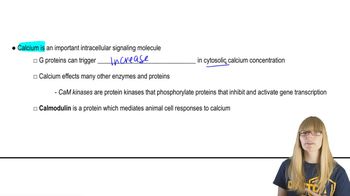
 06:29
06:29