Skip to main content
Cell Biology
My Course
Learn
Exam Prep
AI Tutor
Study Guides
Flashcards
Explore
Try the app
My Course
Learn
Exam Prep
AI Tutor
Study Guides
Flashcards
Explore
Try the app
Back
Extracellular Matrix of Animal Cells definitions
You can tap to flip the card.
Extracellular Matrix
You can tap to flip the card.
👆
Extracellular Matrix
A network of fibers and proteins outside cells, providing structural support and connecting cells within tissues.
Track progress
Control buttons has been changed to "navigation" mode.
1/14
Related flashcards
Related practice
Recommended videos
Extracellular Matrix of Animal Cells quiz #1
Extracellular Matrix of Animal Cells
10 Terms
Extracellular Matrix of Animal Cells
18. Cell Junctions and Tissues
7 problems
Topic
The Basal Lamina
18. Cell Junctions and Tissues
7 problems
Topic
18. Cell Junctions and Tissues
5 topics
15 problems
Chapter
Guided course
05:46
Extracellular Matrix
3
views
Terms in this set (14)
Hide definitions
Extracellular Matrix
A network of fibers and proteins outside cells, providing structural support and connecting cells within tissues.
Collagen Fibrils
Strong, fibrous structures formed from collagen, essential for connective tissue strength and integrity.
Fibroblasts
Specialized cells responsible for producing collagen, contributing to the formation of connective tissues.
Elastin
A flexible protein fiber that imparts elasticity to tissues, crucial for organs like skin to stretch and recoil.
Fibronectins
Glycoproteins that link collagen fibers to cells, facilitating cell-matrix adhesion and tissue organization.
Glycoproteins
Molecules composed of proteins and sugars, playing roles in cell adhesion and extracellular matrix structure.
Glycosaminoglycans
Long carbohydrate chains that bind matrix components, contributing to tissue consistency and hydration.
Hyaluron
A specific glycosaminoglycan that fills extracellular space, providing viscosity and structural support.
Integrins
Transmembrane proteins connecting the cytoskeleton to the extracellular matrix, mediating adhesion and signaling.
Cytoskeleton
An internal cellular framework that interacts with integrins to anchor cells to the extracellular matrix.
Anchorage-dependent Growth
A process where cells require attachment to the extracellular matrix via integrins to proliferate.
Connective Tissue
Tissue type rich in extracellular matrix components, providing support and cohesion for cells.
Active Conformation
A structural state of integrins that enables binding to the extracellular matrix and cellular signaling.
Inactive Conformation
A bent state of integrins where they do not interact with the extracellular matrix or transmit signals.
 BackBack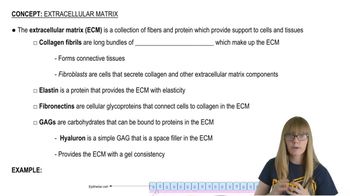
 05:46
05:46