Skip to main content
Cell Biology
My Course
Learn
Exam Prep
AI Tutor
Study Guides
Flashcards
Explore
Try the app
My Course
Learn
Exam Prep
AI Tutor
Study Guides
Flashcards
Explore
Try the app
Back
Control of Cell Death definitions
You can tap to flip the card.
Apoptosis
You can tap to flip the card.
👆
Apoptosis
A regulated, programmed process where a cell self-destructs in a controlled manner, preventing harm to neighboring cells.
Track progress
Control buttons has been changed to "navigation" mode.
1/15
Related flashcards
Related practice
Recommended videos
Control of Cell Death quiz #1
Control of Cell Death
9 Terms
Control of Cell Death
16. Cell Division
7 problems
Topic
Control of Cell Size
16. Cell Division
7 problems
Topic
16. Cell Division - Part 1 of 2
5 topics
14 problems
Chapter
16. Cell Division - Part 2 of 2
5 topics
13 problems
Chapter
Guided course
14:19
Overview
2
views
Guided course
03:44
Triggering Cell Death
3
views
Terms in this set (15)
Hide definitions
Apoptosis
A regulated, programmed process where a cell self-destructs in a controlled manner, preventing harm to neighboring cells.
Necrosis
A form of traumatic cell death resulting from injury or disease, characterized by uncontrolled cell rupture and inflammation.
Caspase
A family of protease enzymes that orchestrate cellular breakdown during programmed cell death by cleaving key cellular components.
Initiator Caspase
A protein that begins the cascade of events in programmed cell death by activating other proteases involved in cellular dismantling.
Executioner Caspase
A protease responsible for degrading cellular structures, directly leading to the physical breakdown of the cell.
Pro-caspase
An inactive precursor of a protease that requires cleavage to become active and participate in cell death processes.
Blebbing
The formation of bulging protrusions on the cell surface, marking the early stages of cellular fragmentation during death.
Apoptotic Body
A membrane-bound vesicle containing cellular fragments, formed during the final stages of programmed cell death.
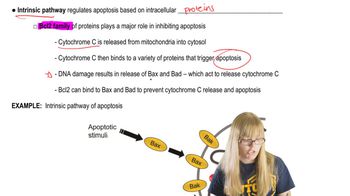
Intrinsic Pathway
A cell death route triggered by internal signals, often involving mitochondrial damage and release of specific proteins.
Extrinsic Pathway
A cell death route initiated by external signals, typically involving immune cell interactions and activation of surface receptors.
Cytochrome c
A mitochondrial protein released into the cytosol upon cellular stress, initiating the cascade leading to cell death.
Bcl-2 Family
A group of proteins that regulate cell death by either promoting or inhibiting the release of mitochondrial factors.
Death Receptor
A plasma membrane protein that, upon ligand binding, triggers the assembly of signaling complexes to initiate cell death.
Death-Inducing Signaling Complex
A multiprotein assembly formed at the cell surface that activates proteases to execute programmed cell death.
Inhibitor of Apoptosis
A molecule that prevents unwanted cell death by blocking the activation or function of proteases involved in apoptosis.
 BackBack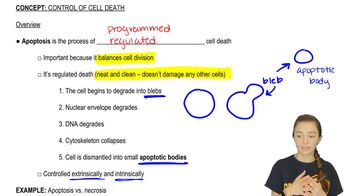
 14:19
14:19