Skip to main content
Cell Biology
My Course
Learn
Exam Prep
AI Tutor
Study Guides
Flashcards
Explore
Try the app
My Course
Learn
Exam Prep
AI Tutor
Study Guides
Flashcards
Explore
Try the app
Back
Chemical Bonds definitions
You can tap to flip the card.
Atom
You can tap to flip the card.
👆
Atom
Basic unit of matter with a core of protons and neutrons, surrounded by electron shells that determine bonding behavior.
Track progress
Control buttons has been changed to "navigation" mode.
1/17
Related flashcards
Related practice
Recommended videos
Chemical Bonds quiz #1
Chemical Bonds
10 Terms
Chemical Bonds
2. Chemical Components of Cells
7 problems
Topic
Acids, Bases, and Buffers
2. Chemical Components of Cells
7 problems
Topic
2. Chemical Components of Cells
5 topics
14 problems
Chapter
Guided course
03:09
Covalent Bonds
4
views
Guided course
06:21
Noncovalent Bonds
3
views
Guided course
02:49
Properties of Atoms
7
views
Terms in this set (17)
Hide definitions
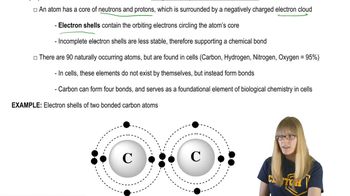
Atom
Basic unit of matter with a core of protons and neutrons, surrounded by electron shells that determine bonding behavior.
Electron Shell
Region around an atomic nucleus where electrons orbit, influencing stability and bonding capacity.
Covalent Bond
Strong connection formed by sharing electrons between atoms, creating stable molecular structures.
Single Bond
Type of covalent linkage involving the sharing of two electrons between two atoms.
Double Bond
Covalent connection where four electrons are shared, resulting in a stronger and shorter bond than a single bond.
Triple Bond
Covalent interaction involving the sharing of six electrons, producing a very strong and short bond.
Polarity
Molecular property arising from unequal electron sharing, leading to partial positive and negative charges.
Electronegativity
Tendency of an atom to attract electrons toward itself within a chemical bond.
Bond Strength
Amount of energy required to break a chemical connection between atoms, reflecting its stability.
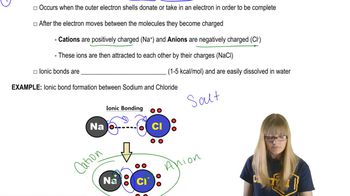
Ionic Bond
Attraction between oppositely charged ions formed by electron transfer, often called a salt bridge.
Cation
Positively charged ion resulting from the loss of one or more electrons.
Anion
Negatively charged ion produced by gaining one or more electrons.
Hydrogen Bond
Weak attraction between a partially positive hydrogen and an electronegative atom, crucial for water’s properties.
Van der Waals Attraction
Nonspecific, weak force arising when atoms approach closely, significant in both polar and nonpolar molecules.
Hydrophobic Effect
Tendency of nonpolar molecules to aggregate in water, minimizing disruption of hydrogen bonding among water molecules.
Molecular Complementarity
Precise fit between molecules, enabling strong binding through multiple interactions, similar to a lock and key.
Affinity
Degree of fit and strength of binding between molecules, increasing with the number and quality of interactions.
 BackBack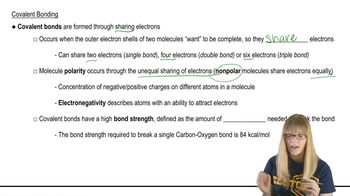
 03:09
03:09