Skip to main content
Cell Biology
My Course
Learn
Exam Prep
AI Tutor
Study Guides
Flashcards
Explore
Try the app
My Course
Learn
Exam Prep
AI Tutor
Study Guides
Flashcards
Explore
Try the app
Back
Breakdown and Utilization of Sugars and Fats definitions
You can tap to flip the card.
Metabolism
You can tap to flip the card.
👆
Metabolism
Sum of all chemical reactions in a cell, encompassing both energy-releasing and energy-consuming processes.
Track progress
Control buttons has been changed to "navigation" mode.
1/15
Related flashcards
Related practice
Recommended videos
Breakdown and Utilization of Sugars and Fats quiz #1
Breakdown and Utilization of Sugars and Fats
10 Terms
Breakdown and Utilization of Sugars and Fats
10. Anerobic Respiration
7 problems
Topic
Glycolysis
10. Anerobic Respiration
7 problems
Topic
10. Anerobic Respiration
4 topics
12 problems
Chapter
Guided course
03:40
Oxygen and Respiration
5
views
Guided course
03:15
Glucose
1
views
Guided course
02:43
Metabolism Review
2
views
Terms in this set (15)
Hide definitions
Metabolism
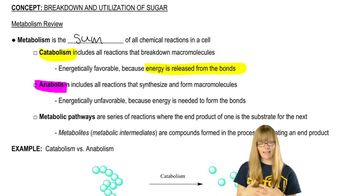
Sum of all chemical reactions in a cell, encompassing both energy-releasing and energy-consuming processes.
Catabolism
Set of reactions that break down macromolecules, releasing energy stored in chemical bonds.
Anabolism
Set of reactions that synthesize macromolecules, requiring an input of energy.
Metabolic Pathway
Series of sequential reactions where each product becomes the substrate for the next step.
Metabolite
Intermediate compound formed during the transformation of a substrate to a final product in metabolism.
Glucose
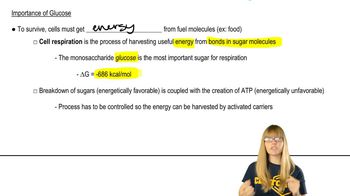
Primary sugar molecule used by cells to harvest energy efficiently through controlled breakdown.
Cellular Respiration
Process that extracts energy from sugar bonds to produce ATP, typically using oxygen.
ATP
Main energy currency of the cell, generated through the breakdown of sugars and other fuels.
Digestion
Initial stage of catabolism where complex food molecules are broken into smaller subunits.
Glycolysis
Cytosolic process converting glucose into pyruvate, generating ATP and electron carriers.
Pyruvate
Three-carbon molecule produced from glucose during glycolysis, serving as a key metabolic intermediate.
Oxidative Phosphorylation
Mitochondrial process producing the majority of cellular ATP, requiring oxygen and generating CO2 and water.
Aerobic Respiration
Energy-yielding pathway using oxygen to fully break down sugars, resulting in high ATP output.
Anaerobic Respiration
Energy-yielding pathway operating without oxygen, resulting in lower ATP production.
Fermentation
Oxygen-independent process converting pyruvate to other products, yielding minimal energy.
 BackBack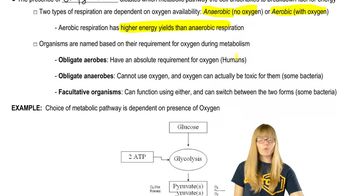
 03:40
03:40