
Textbook Question
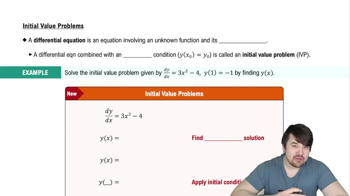
What integral equation is equivalent to the initial value problem y' = f(x), y(x₀) = y₀?

 Verified step by step guidance
 07:33
07:33
 05:03
05:03 04:57
04:57What integral equation is equivalent to the initial value problem y' = f(x), y(x₀) = y₀?
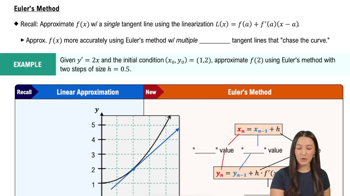
Using Euler’s Method
In Exercises 15–20, use Euler’s method to calculate the first three approximations to the given initial value problem for the specified increment size. Calculate the exact solution and investigate the accuracy of your approximations. Round your results to four decimal places.
y' = 2y/x, y(1) = -1, dx = 0.5
Solving Initial Value Problems
Solve the initial value problems in Exercises 15–20.
dy/dx + xy = x, y(0) = -6
First-Order Linear Equations
Solve the differential equations in Exercises 1–14.
e²ˣy' + 2e²ˣ y = 2x
Is either of the following equations correct? Give reasons for your answers.
a. (1/cosx) ∫ cos x dx = tan x + C
b. (1/cosx) ∫ cos x dx = tan x + C / cos x
In Exercises 39–42, use Euler’s method with the specified step size to estimate the value of the solution at the given point x*. Find the value of the exact solution at x*.
y' = 1 + y², y(0) = 0, dx = 0.1, x* = 1