
Textbook Question
First-Order Linear Equations
Solve the differential equations in Exercises 1–14.
tan θ dr/dθ + r = sin²θ, 0 < θ < π/2

 Verified step by step guidance
 07:33
07:33
 06:06
06:06 05:03
05:03First-Order Linear Equations
Solve the differential equations in Exercises 1–14.
tan θ dr/dθ + r = sin²θ, 0 < θ < π/2
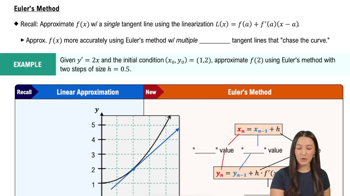
In Exercises 39–42, use Euler’s method with the specified step size to estimate the value of the solution at the given point x*. Find the value of the exact solution at x*.
y′ = √x/y, y > 0, y(0) = 1, dx = 0.1, x* = 1
Show that (0, 0) and (c/d, a/b) are equilibrium points. Explain the meaning of each of these points.
Sailing A sailboat is running along a straight course with the wind providing a constant forward force of 50 lb. The only other force acting on the boat is resistance as the boat moves through the water. The resisting force is numerically equal to five times the boat’s speed, and the initial velocity is 1 ft/sec. What is the maximum velocity in feet per second of the boat under this wind?
Is either of the following equations correct? Give reasons for your answers.
a. (1/cosx) ∫ cos x dx = tan x + C
b. (1/cosx) ∫ cos x dx = tan x + C / cos x
In Exercises 39–42, use Euler’s method with the specified step size to estimate the value of the solution at the given point x*. Find the value of the exact solution at x*.
y' = 1 + y², y(0) = 0, dx = 0.1, x* = 1