Ch. 9 - First-Order Differential Equations
Hass - Thomas' Calculus 15th Edition
Hass15th EditionThomas' CalculusISBN: 9780137616077Not the one you use?Change textbook
Chapter 9, Problem 9.AAE.10

Solve the homogeneous equations in Exercises 5–10. First put the equation in the form of a homogeneous equation.


(x sin y/x - y cos y/x)dx + (x cos y/x) dy = 0

Verified step by step guidance
1
Identify the given differential equation: \(\left(x \sin \frac{y}{x} - y \cos \frac{y}{x}\right) dx + \left(x \cos \frac{y}{x}\right) dy = 0\).
Rewrite the equation in the form \(M(x,y) dx + N(x,y) dy = 0\), where \(M(x,y) = x \sin \frac{y}{x} - y \cos \frac{y}{x}\) and \(N(x,y) = x \cos \frac{y}{x}\).
Check if the equation is homogeneous by verifying if \(M(tx, ty) = t^n M(x,y)\) and \(N(tx, ty) = t^n N(x,y)\) for some degree \(n\). Since the functions depend on \(\frac{y}{x}\), this suggests homogeneity of degree 1.
Use the substitution \(v = \frac{y}{x}\), which implies \(y = vx\) and \(dy = v dx + x dv\) to transform the equation into a separable form in terms of \(v\) and \(x\).
Substitute \(y\) and \(dy\) into the original equation, simplify, and then separate variables to prepare for integration.

Verified video answer for a similar problem:

This video solution was recommended by our tutors as helpful for the problem above.
Video duration:
7m
Was this helpful?

Key Concepts

Here are the essential concepts you must grasp in order to answer the question correctly.

Homogeneous Differential Equations

A differential equation is homogeneous if it can be expressed so that each term is a function of the ratio y/x. This allows substitution like v = y/x to simplify the equation into a separable form, making it easier to solve.
Recommended video:
07:39
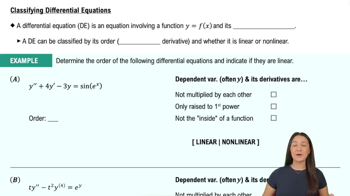
Classifying Differential Equations

Substitution Method (v = y/x)

By substituting v = y/x, the original variables are transformed, reducing the equation to one involving v and x only. This substitution leverages the homogeneity property and helps convert the differential equation into a separable or integrable form.
Recommended video:
06:30
Disk Method Using y-Axis

Separable Differential Equations

Once the substitution is made, the resulting equation often becomes separable, meaning it can be written as a product of a function of v and a function of x. This allows integration on both sides separately to find the solution.
Recommended video:
06:06
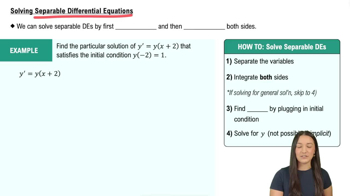
Solving Separable Differential Equations