Ch. 9 - First-Order Differential Equations
Hass - Thomas' Calculus 15th Edition
Hass15th EditionThomas' CalculusISBN: 9780137616077Not the one you use?Change textbook
Chapter 9, Problem 9.2.22b

Solve the following initial value problem for u as a function of t:


du/dt + (k/m) u = 0 (k and m positive constants), u(0) = u₀


b. as a separable equation.

Verified step by step guidance
1
Rewrite the differential equation \( \frac{du}{dt} + \frac{k}{m} u = 0 \) in a form that isolates \( \frac{du}{dt} \): \[ \frac{du}{dt} = -\frac{k}{m} u \].
Recognize that this is a separable differential equation, so separate the variables \( u \) and \( t \) by dividing both sides by \( u \) and multiplying both sides by \( dt \): \[ \frac{1}{u} du = -\frac{k}{m} dt \].
Integrate both sides: \[ \int \frac{1}{u} du = \int -\frac{k}{m} dt \]. This gives \( \ln|u| = -\frac{k}{m} t + C \), where \( C \) is the constant of integration.
Solve for \( u \) by exponentiating both sides: \[ u = e^{ -\frac{k}{m} t + C } = e^{C} e^{ -\frac{k}{m} t } \]. Let \( A = e^{C} \) to simplify the expression.
Use the initial condition \( u(0) = u_0 \) to find \( A \): \[ u_0 = A e^{0} = A \]. Therefore, the solution is \[ u(t) = u_0 e^{ -\frac{k}{m} t } \].

Verified video answer for a similar problem:

This video solution was recommended by our tutors as helpful for the problem above.
Video duration:
3m
Was this helpful?

Key Concepts

Here are the essential concepts you must grasp in order to answer the question correctly.

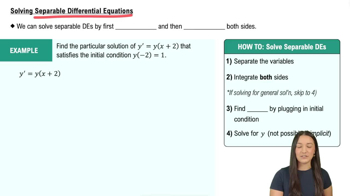
Separable Differential Equations

A separable differential equation can be written as the product of a function of the dependent variable and a function of the independent variable. This allows the variables to be separated on opposite sides of the equation, enabling integration with respect to each variable independently.
Recommended video:
06:06
Solving Separable Differential Equations

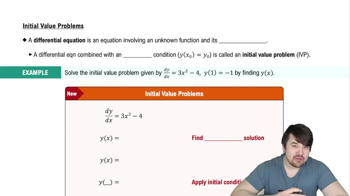
Initial Value Problem (IVP)

An initial value problem specifies the value of the unknown function at a particular point, providing a unique solution to a differential equation. Here, u(0) = u₀ sets the starting condition needed to determine the constant of integration after solving.
Recommended video:
05:03
Initial Value Problems

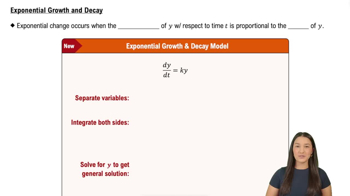
Exponential Decay Solution

The given differential equation models exponential decay, where the rate of change of u is proportional to -u. Solving the separable equation leads to a solution of the form u(t) = u₀ e^(-kt/m), showing how u decreases over time.
Recommended video:
09:29
Exponential Growth & Decay