Ch. 9 - First-Order Differential Equations
Hass - Thomas' Calculus 15th Edition
Hass15th EditionThomas' CalculusISBN: 9780137616077Not the one you use?Change textbook
Chapter 9, Problem 9.PE.13

In Exercises 1–22, solve the differential equation.


(1+eˣ) dy + (yeˣ + e⁻ˣ) dx = 0

Verified step by step guidance
1
Rewrite the given differential equation in the form \(M(x,y)\,dx + N(x,y)\,dy = 0\). Here, identify \(M(x,y)\) and \(N(x,y)\) from the equation \((1+e^{x})\,dy + (ye^{x} + e^{-x})\,dx = 0\). This gives \(M(x,y) = ye^{x} + e^{-x}\) and \(N(x,y) = 1 + e^{x}\).
Check if the differential equation is exact by computing the partial derivatives \(\frac{\partial M}{\partial y}\) and \(\frac{\partial N}{\partial x}\). Calculate \(\frac{\partial M}{\partial y}\) and \(\frac{\partial N}{\partial x}\) and compare them to see if they are equal.
If the equation is not exact, find an integrating factor that depends on either \(x\) or \(y\) to make it exact. To do this, use the formula for integrating factors: for example, if \(\frac{\partial}{\partial y} \left( \frac{M}{N} \right)\) depends only on \(x\), then an integrating factor depending on \(x\) might exist, and similarly for \(y\).
Once the equation is exact (either originally or after multiplying by the integrating factor), find the potential function \(\Psi(x,y)\) such that \(\frac{\partial \Psi}{\partial x} = M\) and \(\frac{\partial \Psi}{\partial y} = N\). Integrate \(M\) with respect to \(x\) to find \(\Psi(x,y)\) up to a function of \(y\), then differentiate this expression with respect to \(y\) and set it equal to \(N\) to determine the unknown function of \(y\).
Write the implicit solution as \(\Psi(x,y) = C\), where \(C\) is a constant. This represents the general solution to the differential equation.

Verified video answer for a similar problem:

This video solution was recommended by our tutors as helpful for the problem above.
Video duration:
7m
Was this helpful?

Key Concepts

Here are the essential concepts you must grasp in order to answer the question correctly.

Differential Equations and Their Forms

A differential equation relates a function with its derivatives. Recognizing the form, such as separable, exact, or linear, is essential for choosing the appropriate solution method. Here, the equation involves both dy and dx terms, suggesting it may be an exact or integrating factor problem.
Recommended video:
07:39
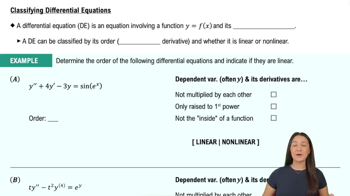
Classifying Differential Equations

Exact Differential Equations

An exact differential equation can be written as dF = 0 for some function F(x,y), meaning the equation corresponds to the total differential of F. To check exactness, verify if the partial derivatives of the coefficient functions satisfy Clairaut's theorem (∂M/∂y = ∂N/∂x). If exact, the solution is F(x,y) = C.
Recommended video:
07:39
Classifying Differential Equations

Integrating Factors

If a differential equation is not exact, an integrating factor is a function that, when multiplied by the equation, makes it exact. Integrating factors often depend on x or y alone and help transform the equation into a solvable form. Identifying and applying the correct integrating factor is key to solving non-exact equations.
Recommended video:
06:18
Integration by Parts for Definite Integrals