Centroid: Find the centroid of the region bounded by the x-axis, the curve y = csc x, and the lines x = π/6, x = 5π/6.
Ch. 8 - Techniques of Integration
Chapter 8, Problem 8.1.46
Volume: Find the volume of the solid generated by revolving the region in Exercise 45 about the x-axis.
Verified step by step guidance1
Identify the region described in Exercise 45. Since the problem references a previous exercise, first recall or write down the functions and the interval that define the region to be revolved around the x-axis.
Set up the volume integral using the disk or washer method. Because the solid is generated by revolving around the x-axis, the volume \(V\) can be expressed as \(V = \pi \int_a^b [R(x)]^2 \, dx\), where \(R(x)\) is the radius of the cross-sectional disk at position \(x\).
Determine the radius function \(R(x)\). This radius is typically the distance from the x-axis to the curve defining the boundary of the region. If there are two curves, use the difference of their values to find the outer and inner radii for the washer method.
Set the limits of integration \(a\) and \(b\) based on the interval over which the region extends along the x-axis.
Write the integral explicitly with the squared radius function and limits, then prepare to evaluate the integral to find the volume. (Do not compute the integral yet, just set it up.)

Verified video answer for a similar problem:
This video solution was recommended by our tutors as helpful for the problem above.
Video duration:
6mWas this helpful?
Key Concepts
Here are the essential concepts you must grasp in order to answer the question correctly.
Volume of Solids of Revolution
This concept involves finding the volume of a 3D solid formed by rotating a 2D region around an axis. The volume is typically calculated using integral calculus, where the cross-sectional area perpendicular to the axis of rotation is integrated along the axis.
Recommended video:
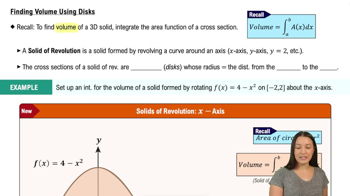
Finding Volume Using Disks
Disk and Washer Methods
These are techniques to compute volumes of solids of revolution. The disk method applies when the solid has no hole (solid disks), while the washer method is used when there is a hollow center, involving subtracting the inner radius area from the outer radius area in the integral.
Recommended video:
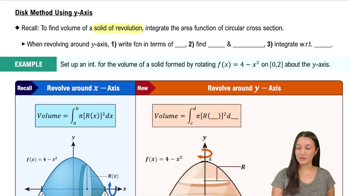
Disk Method Using y-Axis
Setting up the Integral with Proper Limits
To find the volume, you must correctly identify the bounds of integration along the axis of rotation and express the radius (or radii) of the disks or washers as functions of x (or y). Accurate limits and radius expressions ensure the integral represents the volume precisely.
Recommended video:
Improper Integrals: Infinite Intervals
Related Practice
Textbook Question
1
views
Textbook Question
Finding volume: Find the volume of the solid generated by revolving the region in the first quadrant bounded by the coordinate axes, the curve y = e^x, and the line x = ln(2) about the line x = ln(2).
Textbook Question
Expand the quotients in Exercises 1–8 by partial fractions.
(2x + 2) / (x² - 2x + 1)
Textbook Question
The integrals in Exercises 1–44 are in no particular order. Evaluate each integral using any algebraic method, trigonometric identity, or substitution you think is appropriate.
∫₁² (8 dx / (x² - 2x + 2))
Textbook Question
Evaluate the integrals in Exercises 31–56. Some integrals do not require integration by parts.
∫ e√x / √x dx
Textbook Question
In Exercises 21–32, express the integrand as a sum of partial fractions and evaluate the integrals.
∫ (s⁴ + 81) / (s(s² + 9)²) ds
1
views