
Ch. 8 - Techniques of Integration
Hass - Thomas' Calculus 15th Edition
Hass15th EditionThomas' CalculusISBN: 9780137616077Not the one you use?Change textbook
Chapter 8, Problem 8.1.54e

Using different substitutions
Show that the integral
∫((x² - 1)(x + 1))^(-2/3) dx
can be evaluated with any of the following substitutions.
e. u = tan^(-1) ((x - 1)/2)
What is the value of the integral?

Verified step by step guidance
1
Start with the integral \( \int ((x^2 - 1)(x + 1))^{-2/3} \, dx \). First, simplify the expression inside the integral. Notice that \( x^2 - 1 = (x - 1)(x + 1) \), so the integrand becomes \( ((x - 1)(x + 1)^2)^{-2/3} \).
Rewrite the integrand as \( (x - 1)^{-2/3} (x + 1)^{-4/3} \) by distributing the exponent \( -2/3 \) to each factor inside the parentheses.
Use the substitution \( u = \tan^{-1} \left( \frac{x - 1}{2} \right) \). This means \( \frac{x - 1}{2} = \tan u \), so \( x - 1 = 2 \tan u \).
Differentiate \( x - 1 = 2 \tan u \) with respect to \( u \) to find \( dx \) in terms of \( du \): \( dx = 2 \sec^2 u \, du \).
Express \( (x + 1) \) in terms of \( u \) using the substitution and simplify the integrand accordingly. Then rewrite the entire integral in terms of \( u \) and \( du \), which will allow you to integrate with respect to \( u \).

Verified video answer for a similar problem:

This video solution was recommended by our tutors as helpful for the problem above.
Video duration:
4m
Was this helpful?

Key Concepts

Here are the essential concepts you must grasp in order to answer the question correctly.

Integration by Substitution

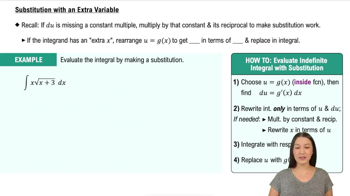
Integration by substitution is a method to simplify integrals by changing variables. It involves choosing a substitution u = g(x) that transforms the integral into a simpler form in terms of u, making it easier to evaluate. This technique is especially useful when the integrand contains composite functions.
Recommended video:
04:27
Substitution With an Extra Variable

Inverse Trigonometric Substitution

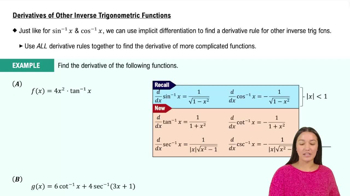
Inverse trigonometric substitution involves substituting a variable with an inverse trigonometric function, such as u = arctan((x - a)/b), to simplify integrals involving algebraic expressions. This substitution leverages trigonometric identities to transform complicated expressions into integrable forms.
Recommended video:
06:35
Derivatives of Other Inverse Trigonometric Functions

Handling Rational Exponents in Integrals

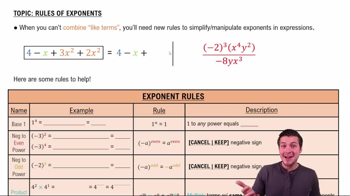
Integrals with rational exponents, like powers of -2/3, require careful manipulation of the integrand. Understanding how to rewrite and simplify expressions with fractional powers is essential, often involving factoring or substitution to convert the integral into a standard form.
Recommended video:
Guided course
7:39
Introduction to Exponent Rules
Related Practice
Textbook Question

The instructions for the integrals in Exercises 1–10 have three parts, one for the Midpoint Rule, one for the Trapezoidal Rule, and one for Simpson’s Rule.

II. Using the Trapezoidal Rule

b. Evaluate the integral directly and find |ET|.

∫ from 0 to 2 of (t³ + t) dt

Textbook Question

The instructions for the integrals in Exercises 1–10 have three parts, one for the Midpoint Rule, one for the Trapezoidal Rule, and one for Simpson’s Rule.

II. Using the Trapezoidal Rule

b. Evaluate the integral directly and find |ET|.

∫ from 0 to π of sin(t) dt

Textbook Question

Using different substitutions

Show that the integral

∫((x² - 1)(x + 1))^(-2/3) dx

can be evaluated with any of the following substitutions.

f. u = arccos x

What is the value of the integral?

1
views
Textbook Question

The instructions for the integrals in Exercises 1–10 have three parts, one for the Midpoint Rule, one for the Trapezoidal Rule, and one for Simpson’s Rule.

III. Using Simpson's Rule

a. Estimate the integral with n = 4 steps and find an upper bound for |ES|.

∫ from 1 to 2 of 1 / s² ds

Textbook Question

The instructions for the integrals in Exercises 1–10 have three parts, one for the Midpoint Rule, one for the Trapezoidal Rule, and one for Simpson’s Rule.

II. Using the Trapezoidal Rule

b. Evaluate the integral directly and find |ET|.

∫ from 1 to 3 of (2x - 1) dx

Textbook Question

The instructions for the integrals in Exercises 1–10 have three parts, one for the Midpoint Rule, one for the Trapezoidal Rule, and one for Simpson’s Rule.

II. Using the Trapezoidal Rule

b. Evaluate the integral directly and find |ET|.

∫ from 1 to 2 of x dx