Ch. 8 - Techniques of Integration
Hass - Thomas' Calculus 15th Edition
Hass15th EditionThomas' CalculusISBN: 9780137616077Not the one you use?Change textbook
Chapter 8, Problem 8.1.26

The integrals in Exercises 1–44 are in no particular order. Evaluate each integral using any algebraic method, trigonometric identity, or substitution you think is appropriate.
∫ (6 dy / √y(1 + y))

Verified step by step guidance
1
Rewrite the integral to make it clearer: \(\int \frac{6}{\sqrt{y}(1 + y)} \, dy\).
Express \(\sqrt{y}\) as \(y^{1/2}\) and rewrite the integral as \(\int \frac{6}{y^{1/2}(1 + y)} \, dy\).
Consider the substitution \(y = t^2\), so that \(dy = 2t \, dt\) and \(\sqrt{y} = t\).
Rewrite the integral in terms of \(t\): replace \(y\) and \(dy\) accordingly, then simplify the expression.
After substitution, simplify the integral and look for a method to integrate, such as partial fractions or a direct algebraic simplification.

Verified video answer for a similar problem:

This video solution was recommended by our tutors as helpful for the problem above.
Video duration:
6m
Was this helpful?

Key Concepts

Here are the essential concepts you must grasp in order to answer the question correctly.

Integration by Substitution

Integration by substitution involves changing variables to simplify an integral. By letting a new variable represent a part of the integrand, the integral can become easier to evaluate. This method is especially useful when the integrand contains composite functions or expressions under radicals.
Recommended video:
04:27
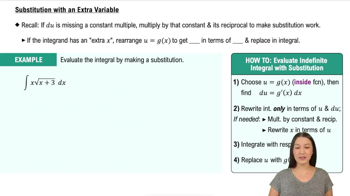
Substitution With an Extra Variable

Algebraic Manipulation of Integrands

Algebraic manipulation includes rewriting the integrand to a more convenient form, such as factoring, expanding, or simplifying expressions. This step can reveal standard integral forms or make substitution more straightforward, facilitating the integration process.
Recommended video:
05:22
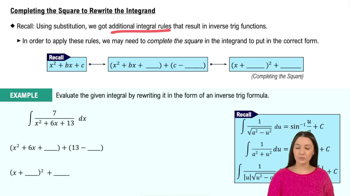
Completing the Square to Rewrite the Integrand

Properties of Radicals and Exponents

Understanding how to handle radicals and fractional exponents is crucial when integrating functions involving roots. Converting radicals to fractional powers allows the use of power rule integration, and recognizing how to simplify expressions under the root helps in choosing the right substitution.
Recommended video:
06:21
Properties of Functions