Ch. 8 - Techniques of Integration
Hass - Thomas' Calculus 15th Edition
Hass15th EditionThomas' CalculusISBN: 9780137616077Not the one you use?Change textbook
Chapter 8, Problem 8.8.22

The integrals in Exercises 1–34 converge. Evaluate the integrals without using tables.
∫₀^∞ 2e^(−θ) sinθ dθ

Verified step by step guidance
1
Recognize that the integral is of the form \(\int_0^{\infty} e^{-a\theta} \sin(b\theta) \, d\theta\) where \(a = 1\) and \(b = 1\), but here the integrand is \(2 e^{-\theta} \sin \theta\). Factor out the constant 2 to write the integral as \(2 \int_0^{\infty} e^{-\theta} \sin \theta \, d\theta\).
Recall the standard formula for the integral \(\int_0^{\infty} e^{-p x} \sin(q x) \, dx = \frac{q}{p^2 + q^2}\), valid for \(p > 0\). Here, identify \(p = 1\) and \(q = 1\).
Apply the formula to evaluate \(\int_0^{\infty} e^{-\theta} \sin \theta \, d\theta = \frac{1}{1^2 + 1^2} = \frac{1}{2}\).
Multiply the result by the constant factor 2 that was factored out initially, so the original integral becomes \(2 \times \frac{1}{2}\).
Conclude that the value of the integral is the product found in the previous step, which completes the evaluation without using tables.

Verified video answer for a similar problem:

This video solution was recommended by our tutors as helpful for the problem above.
Video duration:
5m
Was this helpful?

Key Concepts

Here are the essential concepts you must grasp in order to answer the question correctly.

Improper Integrals

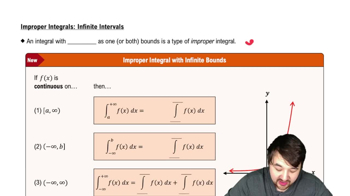
Improper integrals involve integration over an infinite interval or integrands with infinite discontinuities. To evaluate them, one typically takes limits to handle the infinite bounds, ensuring the integral converges to a finite value.
Recommended video:
11:11
Improper Integrals: Infinite Intervals

Integration of Exponential and Trigonometric Functions

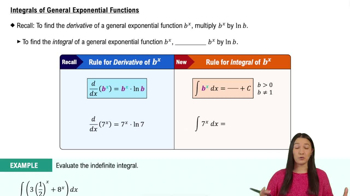
Integrals involving products of exponential and trigonometric functions can be solved using integration techniques such as integration by parts or recognizing standard integral forms. These often result in expressions involving both sine and cosine terms.
Recommended video:
05:11
Integrals of General Exponential Functions

Convergence of Integrals with Oscillatory Functions

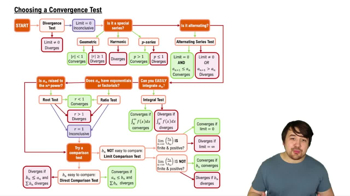
When integrating functions like e^(−θ) sinθ over [0, ∞), the exponential decay ensures the integral converges despite the oscillatory sine term. Understanding how the decay dominates oscillations is key to confirming convergence.
Recommended video:
07:51
Choosing a Convergence Test