Centroid: Find the centroid of the region bounded by the x-axis, the curve y = csc x, and the lines x = π/6, x = 5π/6.
Ch. 8 - Techniques of Integration
Chapter 8, Problem 8.8.2
The integrals in Exercises 1–34 converge. Evaluate the integrals without using tables.
∫₁^∞ dx / x^1.001
Verified step by step guidance1
Identify the integral as an improper integral because the upper limit is infinity: \(\int_1^{\infty} \frac{dx}{x^{1.001}}\).
Rewrite the integral using exponent notation: \(\int_1^{\infty} x^{-1.001} \, dx\).
Find the antiderivative of the integrand. Recall that for \(\int x^n \, dx = \frac{x^{n+1}}{n+1} + C\) when \(n \neq -1\). Here, \(n = -1.001\), so the antiderivative is \(\frac{x^{-0.001}}{-0.001} + C\).
Set up the limit for the improper integral: \(\lim_{t \to \infty} \left[ \frac{x^{-0.001}}{-0.001} \right]_1^{t}\).
Evaluate the limit by substituting the bounds and simplifying the expression to find the value of the integral.

Verified video answer for a similar problem:
This video solution was recommended by our tutors as helpful for the problem above.
Video duration:
4mWas this helpful?
Key Concepts
Here are the essential concepts you must grasp in order to answer the question correctly.
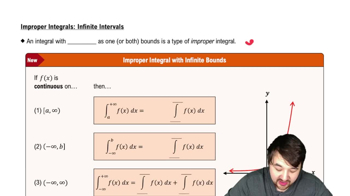
Improper Integrals
Improper integrals involve integration over an infinite interval or integrands with infinite discontinuities. To evaluate them, we replace the infinite limit with a variable and take the limit as it approaches infinity, ensuring the integral converges to a finite value.
Recommended video:
Improper Integrals: Infinite Intervals
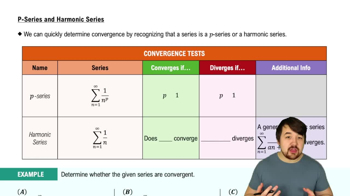
Convergence of p-integrals
A p-integral of the form ∫₁^∞ 1/x^p dx converges if and only if p > 1. This condition ensures the area under the curve decreases sufficiently fast to produce a finite result, which is crucial for determining whether the given integral converges.
Recommended video:
P-Series and Harmonic Series
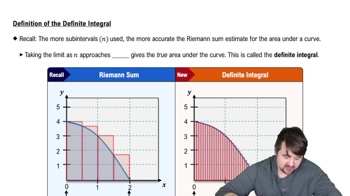
Evaluating Definite Integrals of Power Functions
To evaluate integrals of the form ∫ x^n dx, we use the power rule: ∫ x^n dx = (x^(n+1)) / (n+1) + C, for n ≠ -1. For definite integrals, we apply the limits after integration to find the exact value.
Recommended video:
Definition of the Definite Integral
Related Practice
Textbook Question
1
views
Textbook Question
In Exercises 21–32, express the integrand as a sum of partial fractions and evaluate the integrals.
∫ (s⁴ + 81) / (s(s² + 9)²) ds
1
views
Textbook Question
The integrals in Exercises 1–44 are in no particular order. Evaluate each integral using any algebraic method, trigonometric identity, or substitution you think is appropriate.
∫ (tan θ + 3 / sin θ) dθ
Textbook Question
Evaluate the integrals in Exercises 33–52.
∫ cot³(t) csc⁴(t) dt
Textbook Question
Evaluate the integrals in Exercises 23–32.
∫_{π/2}^{3π/4} √(1 - sin(2x)) dx
1
views
Textbook Question
The integrals in Exercises 1–44 are in no particular order. Evaluate each integral using any algebraic method, trigonometric identity, or substitution you think is appropriate.
∫ (dx / ((2x + 1)√(4x + 4x²)))