

Ch. 8 - Techniques of Integration
Hass - Thomas' Calculus 15th Edition
Hass15th EditionThomas' CalculusISBN: 9780137616077Not the one you use?Change textbook
Chapter 8, Problem 8.7.2h

The instructions for the integrals in Exercises 1–10 have three parts, one for the Midpoint Rule, one for the Trapezoidal Rule, and one for Simpson’s Rule.
III. Using Simpson's Rule
b. Evaluate the integral directly and find |ES|.
∫ from 1 to 3 of (2x - 1) dx

Verified step by step guidance
1
First, write down the integral to be evaluated directly: \(\int_{1}^{3} (2x - 1) \, dx\).
Recall the antiderivative of the integrand. For the function \(f(x) = 2x - 1\), find \(F(x)\) such that \(F'(x) = 2x - 1\).
Compute the antiderivative: \(F(x) = x^{2} - x + C\), where \(C\) is the constant of integration.
Evaluate the definite integral using the Fundamental Theorem of Calculus: calculate \(F(3) - F(1)\).
To find the Simpson's Rule error bound \(|E_{S}|\), use the formula \(|E_{S}| \leq \frac{(b - a)^{5}}{180 n^{4}} \max_{a \leq x \leq b} |f^{(4)}(x)|\). Since the integrand is a polynomial of degree 1, determine \(f^{(4)}(x)\) and use it to find \(|E_{S}|\).

Verified video answer for a similar problem:

This video solution was recommended by our tutors as helpful for the problem above.
Video duration:
2m
Was this helpful?

Key Concepts

Here are the essential concepts you must grasp in order to answer the question correctly.

Simpson's Rule

Simpson's Rule is a numerical method for approximating definite integrals by dividing the interval into an even number of subintervals and fitting parabolas through the function values. It generally provides more accurate results than the Midpoint or Trapezoidal Rules for smooth functions.
Recommended video:

Exact Evaluation of Definite Integrals

Exact evaluation involves finding the antiderivative of the integrand and applying the Fundamental Theorem of Calculus to compute the integral's exact value. This provides a benchmark to compare against numerical approximations.
Recommended video:
05:43
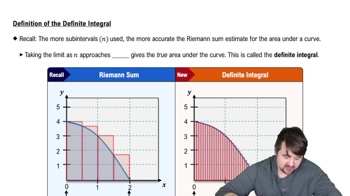
Definition of the Definite Integral

Error Bound for Simpson's Rule (|ES|)

The error bound |ES| estimates the maximum possible difference between the exact integral and the Simpson's Rule approximation. It depends on the fourth derivative of the function and the width of the subintervals, helping assess the accuracy of the numerical method.
Recommended video:
07:01
Intro to the Chain Rule Example 1
Related Practice
Textbook Question

The instructions for the integrals in Exercises 1–10 have three parts, one for the Midpoint Rule, one for the Trapezoidal Rule, and one for Simpson’s Rule.

III. Using Simpson's Rule

b. Evaluate the integral directly and find |ES|.

∫ from 0 to π of sin(t) dt

Textbook Question

The instructions for the integrals in Exercises 1–10 have three parts, one for the Midpoint Rule, one for the Trapezoidal Rule, and one for Simpson’s Rule.

III. Using Simpson's Rule

b. Evaluate the integral directly and find |ES|.

∫ from 1 to 2 of 1 / s² ds

Textbook Question

The instructions for the integrals in Exercises 1–10 have three parts, one for the Midpoint Rule, one for the Trapezoidal Rule, and one for Simpson’s Rule.

III. Using Simpson's Rule

b. Evaluate the integral directly and find |ES|.

∫ from -2 to 0 of (x² - 1) dx

Textbook Question

The instructions for the integrals in Exercises 1–10 have three parts, one for the Midpoint Rule, one for the Trapezoidal Rule, and one for Simpson’s Rule.

III. Using Simpson's Rule

a. Estimate the integral with n = 4 steps and find an upper bound for |ES|.

∫ from -2 to 0 of (x² - 1) dx

Textbook Question

The instructions for the integrals in Exercises 1–10 have three parts, one for the Midpoint Rule, one for the Trapezoidal Rule, and one for Simpson’s Rule.

III. Using Simpson's Rule

b. Evaluate the integral directly and find |ES|.

∫ from 1 to 2 of x dx

Textbook Question

The instructions for the integrals in Exercises 1–10 have three parts, one for the Midpoint Rule, one for the Trapezoidal Rule, and one for Simpson’s Rule.

III. Using Simpson's Rule

a. Estimate the integral with n = 4 steps and find an upper bound for |ES|.

∫ from 0 to 2 of (t³ + t) dt