Ch. 8 - Techniques of Integration
Hass - Thomas' Calculus 15th Edition
Hass15th EditionThomas' CalculusISBN: 9780137616077Not the one you use?Change textbook
Chapter 8, Problem 8.8.76

In Exercises 69–80, determine whether the improper integral converges or diverges. If it converges, evaluate the integral.
∫₋∞⁰ x² e^(x³) dx

Verified step by step guidance
1
Identify the integral as an improper integral because the lower limit is negative infinity: \(\int_{-\infty}^0 x^2 e^{x^3} \, dx\).
Consider the behavior of the integrand \(x^2 e^{x^3}\) as \(x \to -\infty\) to determine if the integral converges. Since \(x^3\) tends to \(-\infty\) as \(x \to -\infty\), analyze the exponential term \(e^{x^3}\) in this limit.
Use substitution to simplify the integral. Let \(t = x^3\), then compute \(dt\) in terms of \(dx\): \(dt = 3x^2 dx\), which implies \(x^2 dx = \frac{dt}{3}\).
Rewrite the integral in terms of \(t\) using the substitution: change the limits accordingly (when \(x = -\infty\), \(t = -\infty\); when \(x = 0\), \(t = 0\)), so the integral becomes \(\int_{-\infty}^0 e^t \frac{dt}{3}\).
Evaluate the integral \(\frac{1}{3} \int_{-\infty}^0 e^t dt\) by finding the antiderivative of \(e^t\) and then applying the limits to determine convergence and the value of the integral.

Verified video answer for a similar problem:

This video solution was recommended by our tutors as helpful for the problem above.
Video duration:
6m
Was this helpful?

Key Concepts

Here are the essential concepts you must grasp in order to answer the question correctly.

Improper Integrals

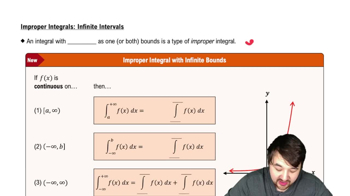
Improper integrals involve integration over infinite intervals or integrands with infinite discontinuities. To evaluate them, limits are used to define the integral as a limit of definite integrals over finite intervals. Determining convergence means checking if this limit exists and is finite.
Recommended video:
11:11
Improper Integrals: Infinite Intervals

Behavior of Exponential Functions with Polynomial Exponents

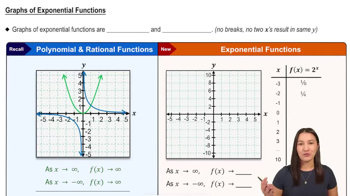
The function e^(x³) combines exponential growth or decay with a cubic polynomial in the exponent. For negative x, x³ is negative and large in magnitude, causing e^(x³) to approach zero rapidly, which affects the convergence of the integral when multiplied by x².
Recommended video:
5:46
Graphs of Exponential Functions

Techniques for Evaluating Improper Integrals

Evaluating improper integrals often requires substitution to simplify the integrand or integration by parts. Recognizing suitable substitutions, such as setting u = x³, can transform the integral into a more manageable form, enabling direct evaluation or application of known integral results.
Recommended video:
11:11
Improper Integrals: Infinite Intervals