Ch. 8 - Techniques of Integration
Hass - Thomas' Calculus 15th Edition
Hass15th EditionThomas' CalculusISBN: 9780137616077Not the one you use?Change textbook
Chapter 8, Problem 8.8.50

In Exercises 35–68, use integration, the Direct Comparison Test, or the Limit Comparison Test to test the integrals for convergence. If more than one method applies, use whatever method you prefer.
∫ from -1 to 1 of (-x ln|x| dx)

Verified step by step guidance
1
First, recognize that the integral is improper because the integrand involves \( \ln|x| \), which is undefined at \( x = 0 \). So, we need to consider the integral as an improper integral with a potential discontinuity at \( x = 0 \).
Rewrite the integral as the sum of two integrals around the point of discontinuity: \( \int_{-1}^{1} -x \ln|x| \, dx = \int_{-1}^{0} -x \ln|x| \, dx + \int_{0}^{1} -x \ln|x| \, dx \).
Since the function \( f(x) = -x \ln|x| \) is an even function (because \( -x \ln|x| \) is symmetric about zero), you can simplify the problem by evaluating \( 2 \int_{0}^{1} -x \ln x \, dx \) instead.
To test for convergence, analyze the behavior of the integrand near \( x = 0 \). Consider the limit \( \lim_{x \to 0^{+}} -x \ln x \). Use L'Hôpital's Rule or known limits to determine if the integrand approaches a finite value or zero.
Since the integrand behaves well near zero and is continuous on \( (0,1] \), conclude that the integral converges. You can also use direct integration techniques or comparison tests with functions like \( x^{p} \) to confirm convergence.

Verified video answer for a similar problem:

This video solution was recommended by our tutors as helpful for the problem above.
Video duration:
9m
Was this helpful?

Key Concepts

Here are the essential concepts you must grasp in order to answer the question correctly.

Improper Integrals and Convergence

An improper integral involves integration over an interval where the function is unbounded or the interval is infinite. To determine convergence, we analyze the behavior near points of discontinuity or infinite limits. For example, integrals with singularities at endpoints require careful limit evaluation to check if the integral converges to a finite value.
Recommended video:
11:11
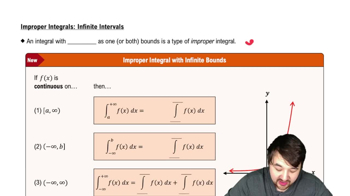
Improper Integrals: Infinite Intervals

Direct Comparison Test

The Direct Comparison Test compares the given integral's integrand to a known function with established convergence behavior. If the integrand is smaller than a convergent function or larger than a divergent one on the interval, we can conclude about the integral's convergence or divergence accordingly.
Recommended video:
09:25
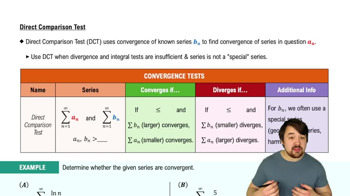
Direct Comparison Test

Limit Comparison Test

The Limit Comparison Test involves taking the limit of the ratio of the given integrand to a simpler function with known convergence properties. If the limit is a positive finite number, both integrals share the same convergence behavior, allowing us to infer the original integral's convergence or divergence.
Recommended video:
07:45
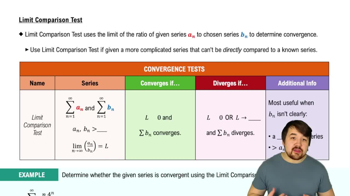
Limit Comparison Test